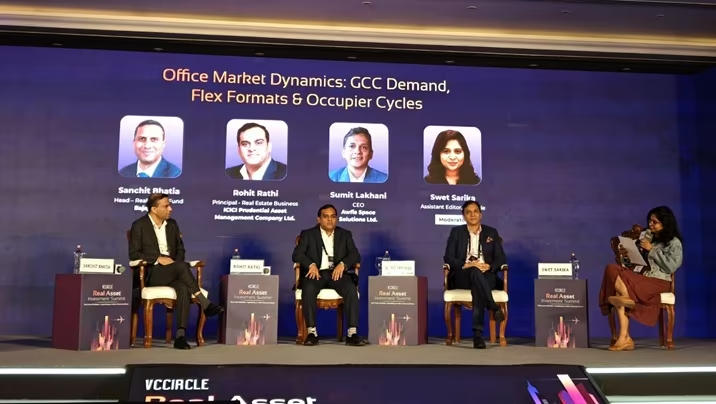
Domestic fund managers are moving from the fringes to the heart of India’s commercial office market amid a cautious investment approach by global institutions, alongside growing demand from global capability centres (GCCs) and flexible workspaces, said panelists at the VCCircle Real Asset Investment Summit 2026 on Thursday.
Sanchit Bhatia, head of the Real Estate Fund at Bajaj Alts; Rohit Rathi, principal at ICICI Prudential AMC Ltd; and Sumit Lakhani, chief executive officer at Awfis Space Solutions Ltd, were speaking on the topic “Office Market Dynamics: GCC Demand, Flex Formats & Occupier Cycles.”
Bhatia said that as developers shift their focus from residential projects to office spaces, there is a need for long-term capital commitment of four to five years.
“These projects need anywhere between $50 million and $70 million of investment, whereas for Brookfield, Blackstone, and the GICs of the world, this is a very small cheque size. It does not fit in their cheque sizes. That's where the domestic funds come in and can make some space for themselves,” he said.
The rise in domestic real estate investment activity is also driven by investors seeking yield-based returns, Rathi said.
“This is a reallocation from the debt portfolio of investors to yield portfolio. So it is just movement of funds from our debt strategy to yield strategy, and the amount looks large, but in terms of overall wealth and asset allocation, still it is lowest,” he said.
Lakhani said occupiers are increasingly prioritising flexibility and convenience.
“That’s why for operators like us today, almost 35% of any incremental leasing is happening into a kind of flex space,” he said.
Lakhani added that premium assets are likely to emerge over the next couple of years, driven by increased institutional capital entering commercial real estate, listings of real estate investment trusts (REITs), and domestic capital inflows.
“From a flex perspective, 35-45% of our client base today is GCCs. Where we are getting a very serious kind of business is more from greenfield GCCs, the GCCs which are setting up in India for the first time. Almost 120-150 of these GCCs are coming every single year,” he said.
Bhatia also said that the rupee’s depreciation is putting foreign funds at a disadvantage while giving domestic investors an edge.
“What that (rupee depreciation) has done is their underwriting now has become even more stringent than before. So the cost advantage they had, they could have been a lower-cost capital provider than, say, me. That advantage is gone for them,” he said, adding that this is creating room for domestic developers.