Lessons from ~4,200 Deals between 2013 and YTD 2025
Here’s what nobody tells you about venture capital: most exits happen long before the champagne-popping IPO moments you read about in TechCrunch. At SAM’SPACE, we spent months analysing 4,200 seed and Series A exits between 2013 and 2024, and what we found challenges everything conventional wisdom tells founders and investors about building successful startups.
The Exit Reality Check
Let’s start with a sobering fact: exits aren’t optional footnotes in investment strategy -they’re the entire point. Yet investors routinely overlook exit planning during due diligence, mesmerised by growth projections and founder charisma. This oversight costs billions.
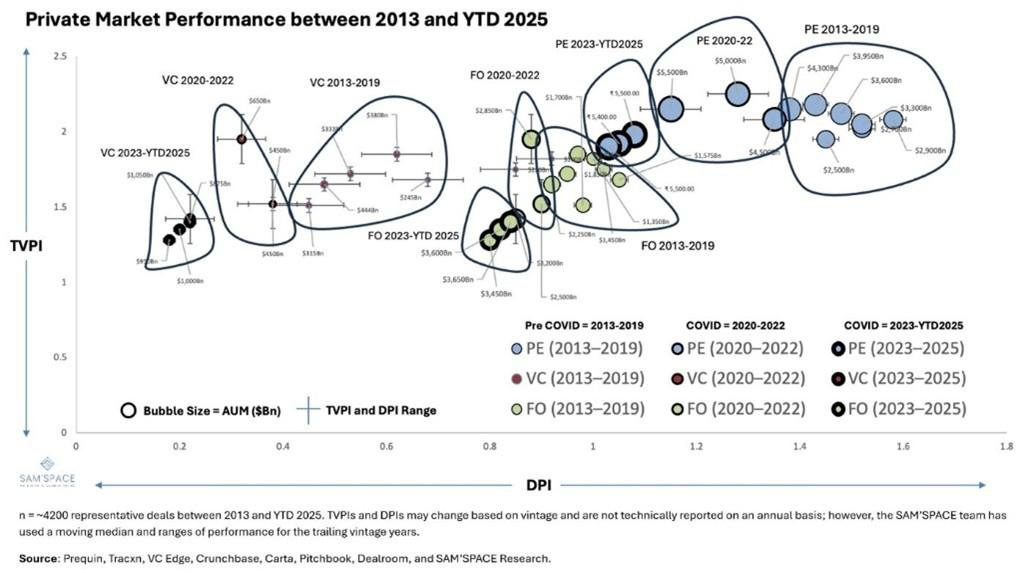
Over the past twelve years, we have tracked approximately ~$10 trillion AUM across Family Offices, Private Equity, and Venture Capital Equity markets. The results? (Refer to the diagram above.) Venture capital consistently underperformed both PE and family offices in delivering returns aligned with their investment theses. DPI, TVPI, and IRRs declined sharply from 2013 to 2022, improved modestly through 2025, but the structural gap persisted.
DPI, TVPI and IRRs for all three declined from 2013 to 2022, particularly during the COVID-19 pandemic, but improved from 2023 to 2025. Private Equity assets outperformed, followed by Family Offices and then Venture Capital. Additionally, VC performance is more skewed than that of PE and FO. Due to incomplete data and unreliable family office returns, our team used conservative estimates for DPI and TVPI.
These differences in asset performance across the VCs, FOs, and PEs are not merely quantitative but also fundamentally reshape the strategic assessment of early-stage investments. Specifically, patterns such as elevated failure rates, the preponderance of strategic acquisitions over public offerings, and the concentration of returns among a small subset of outlier investments necessitate a more nuanced, data-driven approach to exit analysis.
A comprehensive understanding of these exit dynamics is vital for investors and founders to optimise portfolio construction, calibrate risk appetite, and enhance capital allocation efficiency within the broader context of alternative asset classes.
In my LinkedIn article What do Series A asset exits between 2013 and 2024 tell us?, I highlighted the significant gap between expected and realised IRRs for approximately 3,000 Series A assets studied from 2013 to 2024. At SAM’SPACE, we expanded our research to analyse Seed and Series A exits, identifying notable patterns.
Why does this matter? Because understanding exit patterns at seed and Series A stages isn't an academic exercise—it’s survival knowledge for anyone putting capital at risk in early-stage companies.
Seed Exits: Speed, Scale, and Spectacular Failures
Nearly half of all tech startup exits between 2013 and 2024 occurred at the seed or pre-seed stage. Think about that. Companies you’ve never heard of, with products barely out of beta, accounted for 48% of venture-backed exits. This isn’t failure—it’s the ecosystem working exactly as designed.
Seed-Stage Exit Distribution:
Strategic acquisitions were the most prevalent, accounting for 58% of documented seed exits. Facebook’s acquisition of Instagram for $1 billion in 2012 and WhatsApp for $19 billion in 2014 weren’t anomalies—they were simply the most visible examples of a pattern playing out thousands of times across smaller deals.
However, here's where it gets interesting: acquihires and soft landings accounted for another 11%, typically valued between $1 million and $ 5 million. These transactions prioritised talent and intellectual property over revenue or users. Companies like Pebble and CruxLight preserved founder reputation and investor relationships even when the original vision didn’t pan out. In venture capital, failure that protects relationships isn’t failure—it’s data.
Secondary sales accounting for another 11%, emerged as the quiet revolution of the 2020s, allowing early investors to realise gains while companies continued scaling. Lenskart’s secondary at a $5 billion valuation and Ramp’s transactions delivered returns of 200x or more to seed investors. Given persistent market volatility and startup failure rates, we expect secondary sales to remain significant through 2028. However, median deal sizes and valuation multiples are likely to compress as liquidity needs outweigh the patience for higher returns.
IPOs accounted for less than 5% of seed exits but generated the highest multiples—sometimes exceeding 1,000x for early investors. Swiggy’s 2024 IPO at $11.3 billion represented 2,000x+ returns for seed investors who held for ten years. These outliers define fund performance, but they’re called outliers for a reason.
The Valuation Rollercoaster
Median exit valuations for seed-stage companies ranged from $5 million to $ 20 million through strategic M&A between 2013 and 2018, delivering MOICs of 2.5x to 4.2x and IRRs of 20% to 35%—respectable, predictable, portfolio-sustaining returns.
But venture capital doesn’t run on respectable returns. It operates on power law distributions, where a small subset of investments yields disproportionate gains that compensate for losses across the broader portfolio. Instagram, WhatsApp, DoorDash, Snowflake, Coinbase, Stripe, Canva, Flipkart, BYJU’S—these companies produced 100x to 1,000x returns for early investors while 60-70% of their portfolio companies failed to return capital.
This isn’t a bug. It’s the operating system.
Acquihires delivered median returns of 1.0x-1.8x with IRRs of 5-18%. Not exciting, but they preserved optionality and relationships. Meanwhile, 60-70% of seed-funded startups fail completely, highlighting why portfolio diversification isn't optional—it's a matter of survival.
Time Horizons: The Patient Capital Advantage
Exit timing fell into three distinct patterns:
Quick Flips (1-2 years): BookPad’s Yahoo acquisition within twelve months, Instagram’s Facebook deal at 22 months. These reflected strategic acquirers addressing competitive threats rather than building businesses. Between 2015 and 2024, companies like InstaDeep (acquired by BioNTech for $680 million), Segment (acquired by Twilio for $3.2 billion), and Dollar Shave Club (acquired by Unilever for $1 billion) achieved rapid exits when the timing aligned with market shifts.
Medium Gestation (3-7 years): The sweet spot where product-market fit meets defensible positioning. The segment took five years post-Series A before Twilio’s acquisition. Whitehat Jr. went from founding to being acquired by BYJU’S for $300 million in under three years. Runnr and ZipDial followed similar trajectories, rewarding patient capital with substantial multiples.
Long Holds (8-14 years): Where generational wealth gets created. Flipkart took eleven years to reach Walmart’s $16 billion acquisition, turning Accel India’s 2009 seed investment into $800 million—an 800x multiple. Lenskart needed fourteen years to reach its $5 billion secondary. BYJU’S progressed from 2011 seed funding to a $22 billion valuation, delivering 100x+ returns at its peak.
The pattern is clear: long holding periods combined with category-defining execution yield the most significant rewards. But they demand resilience that most investors lack.
Series A: Different Rules, Different Returns
By Series A, companies demonstrate product-market fit, functional teams, and early revenue traction. This maturity reduces risk but limits upside.
Series A Exit Distribution:
Notice the dramatic shift. IPOs dominated Series A exits at 50%, compared to 5.3% for seed—a 10x difference that reflects operational maturity and market readiness. The 2020 IPO surge spectacularly delivered this: DoorDash ($60B), Airbnb ($100B+), Snowflake ($70B peak) generated substantial value for Series A investors.
But market conditions matter. Between 2022 and 2023, IPO activity moderated as valuation scrutiny intensified and volatility increased. The 2025 disconnect between elevated U.S. equity valuations and economic fundamentals increases the risk of a correction, likely constraining IPO activity and forcing a reconsideration of exit strategies.
Strategic M&A remained significant, accounting for 30% of Series A exits, with median values ranging from $50 million to $ 200 million. Instashop’s acquisition by Delivery Hero for $100M+, Siemplify’s Google exit at $500 million, Alpine Immune Sciences’ Vertex deal at $4.9 billion, and Own Company’s Salesforce acquisition for $1.9 billion confirmed that strategic M&A remains dominant at this stage.
Here’s the crucial insight: Series A represents the most commonly acquired cohort across all funding stages. According to Carta data, Series A startups consistently outperformed seed and later-stage acquisitions from 2021 to 2024. Why? Acquirers believe this stage offers optimal risk-reward balance—companies have de-risked technology and early positioning, yet valuations haven't ballooned to Series C/D levels.
Recent blockbusters prove the point: Mandiant (Google, $5.4B), Recorded Future (Mastercard, $2.65B), Altium (Renesas, $5.9B), Nuvei (Advent, $6.3B), Smartsheet (Blackstone/Vista, $8.4B), Schenker (DSV, $15.85B). These weren't distressed sales—they were strategic acquisitions where buyers paid premiums for proven traction before bidding wars inflated prices.
Series A companies typically exited 3-5 years post-funding versus 1-3 years for seed, reflecting operational scaling requirements. This longer horizon is feature, not bug—it allows companies to build the revenue metrics and market positioning that command premium valuations.
The Numbers Don't Lie
Exit probability: Series A companies achieved successful exits at nearly double the rate of seed ventures—12% versus 7%. This probability increased linearly through subsequent rounds: 18% at Series B, 22% at Series C, 29% at Series D.
Returns: Seed investors enjoyed median multiples of 2.5x-4.2x; Series A investors realized 2.0x-3.5x, reflecting higher entry valuations. Over the past thirty years, early-stage funds delivered an average annual return of 21.3% versus 12.6% for late-stage funds—an 8.7 percentage point spread reflecting the structural advantages of earlier entry and higher ownership.
Valuations: Seed valuations stayed relatively stable ($3-16 million pre-money). Series A valuations swung dramatically—peaking at $40 million median in 2021, correcting to $25 million in 2022-2023, stabilising at $30 million by 2024.
What This Means for You
If you’re an investor:
Stage matters less than portfolio construction. Seed funds outperformed not because every investment succeeded, but because asymmetric winners offset failures. Early entry equals higher multiples—seed investors in Instagram and Swiggy achieved life-changing returns that Series A investors couldn't replicate. But Series A doubled the exit probability while maintaining meaningful upside.
Series A represents the M&A sweet spot—most commonly acquired cohort with balanced risk-return. IPO paths become clearer at Series A (50% versus 5.3% for seed). Patience compounds—highest multiples accrued to investors holding 8-14 years rather than seeking 18-month flips.
If you're a founder:
Structure for multiple exit paths. IPOs are rare; M&A and secondaries are common. Maintain optionality through clean cap tables. Speed isn't everything—BookPad exited in twelve months, Lenskart took fourteen years. Both delivered strong returns relative to entry points.
Revenue matters at Series A, vision matters at seed. Seed exits happened pre-revenue; Series A exits required $1-10 million ARR for favourable valuations. Reaching Series A doubles exit probability and makes you the most attractive acquisition target in the market.
The Road Ahead
The venture ecosystem from 2013 to 2024 exhibited pronounced ambition, pervasive volatility, and uneven resilience. Seed investments delivered higher multiples but lower success rates. Series A offered better odds but lower returns—both rewarded patient capital, disciplined portfolio construction, and strong alignment between founders and investors.
For those operating across India, Europe, the United States, the Middle East, and the Asia Pacific, the evidence is clear: diversify portfolios broadly, prioritise scalable business models, and manage liquidity deliberately. Regarding each exit, not just as a financial return but as an organisational learning and strategic reinvestment opportunity.
The forthcoming decade will introduce new geographies, industries, and exit channels. Those applying data-driven analytical rigour to early-stage decisions will best adapt to evolving dynamics and shape the next generation of successful ventures.
Success depends on integrating adaptive strategy, continual learning, and empirical decision-making.
That’s not inspiration, it's survival instruction.
No VCCircle journalist was involved in the creation/production of this content.
Insights Focus is a marketing initiative for sponsored posts. No VCCircle journalist was involved in the creation of this content.