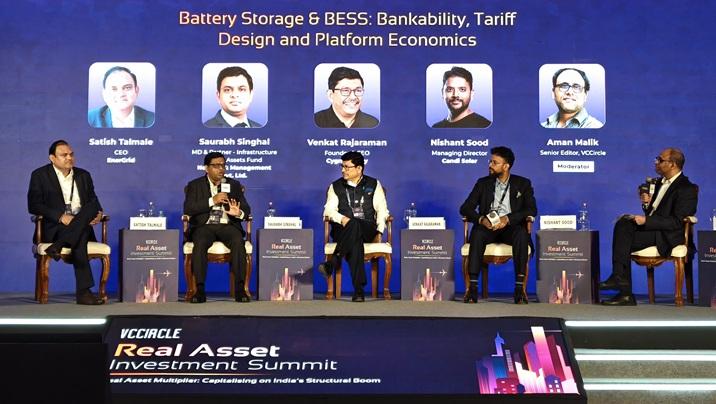
As India moves towards its targeted 500 GW of renewable energy capacity by 2030, panelists at the VCCircle Real Asset Investment Summit 2026 highlighted the realities and challenges facing the sector.
The panel discussion on “Battery Storage & BESS: Bankability, Tariff Design and Platform Economics” featured EnerGrid CEO Satish Talmale, Neo Asset Management’s managing director and partner for infrastructure and real assets fund Saurabh Singhal, Cygni Energy founder and CEO Venkat Rajaraman, and Candi Solar MD Nishant Sood.
While India recorded strong tendering activity in the first half of 2026, converting those bids into commissioned assets remains the real test, Talmale said.
"The kind of bids that are put out is phenomenal, but the question is how to convert that into actual projects. Projects cannot happen on Excel. Finally, it has to hit the ground," he said.
Singhal highlighted demand-supply mismatches in the power sector, pointing out that traditional power generation sources, such as thermal power and pumped storage, would struggle to meet peak demand without storage build-outs.
"The gap between our demand for peak power and available capacity in the next six years to actually supply that peak power is significant. We need 120 gigawatts more by 2032," he said.
Singhal also noted that standalone battery energy storage systems (BESS) offer a markedly different project timeline and risk profile compared to investments in greenfield projects in roads or conventional power, which typically take two-four years to develop.
"Battery is an interesting asset class. It does not take a significant amount of time. It does not require large land procurement. It does not require a large set of approvals, nor does it involve risky civil construction, and so forth,” Singhal said.
However, he cautioned that operating costs remain a concern for the asset class.
To make BESS projects bankable for lenders, contracts must account for how storage behaves over a 10- to 15-year operating life, particularly in terms of cell degradation, round-trip efficiency, and system availability, Rajaraman said.
"Solar is a generating asset, whereas battery energy storage is a real energy storage asset... How much it is going to deliver at the end of five, seven, 10 years is basically going to determine the cash flow when you are taking that into account as part of your financing model,” he said.
In the commercial and industrial (C&I) and small and medium enterprise (SME) segments, battery adoption depends heavily on timing arbitrage, such as charging during lower-cost or solar hours and discharging during higher-cost peak tariff windows, said Sood.
Rather than chasing headline assembly capacity reliant on imports, Rajaraman advocated for building core engineering depth and intellectual property (IP), leveraging India’s existing strengths in EV, power electronics, and software.