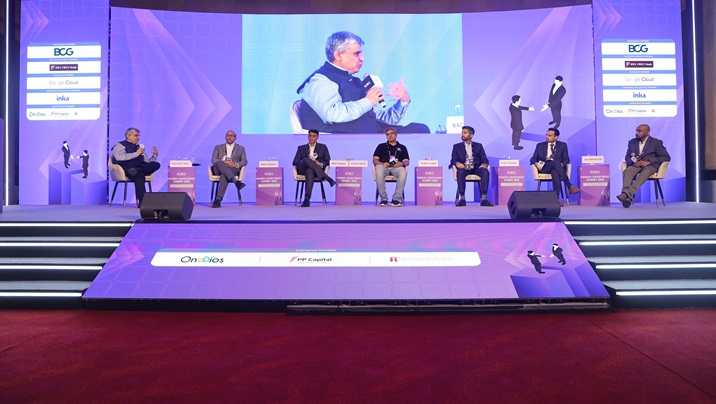
The lack of sufficient information and transparency is among the biggest issues in India's private credit segment, panellists said at the VCCircle Finserv Investment Summit 2026 in Mumbai on Friday.
“From my perspective, investor awareness in terms of understanding returns, coupled with transparency around how capital providers do diligence on investee companies, are among the biggest issues in the private credit segment,“ said Dhruv Shah, managing director and partner at BCG. He added that there is greater transparency in other markets where private credit is a more evolved asset class.
The panel also included Axis AMC’s head of structured credit Nachiket Naik, BlackSoil’s managing director Ankur Bansal, Anicut Capital’s partner Sushant Bhatia, Nuvama Asset Management’s chief investment officer for private credit Amit Kansal, and Pawan Parmeshwar Capital’s managing director Bhumit Choudhary.
Axis AMC’s Naik said higher disclosures and standardisation of frameworks in the private credit segment would enable investors to evaluate different funds.
“While you have all mutual fund portfolio data available today, the information for the private market is scant. Since each fund uses its own valuation metric, it is difficult for an investor to evaluate performance,” he said.
Meanwhile, BlackSoil’s Bansal emphasised the need to attract more capital from offshore investors.
“We need to be able to attract more global capital and, for this, we need stable hedging costs. While domestic private markets have opened up from the regional decent-price model, the next kicker comes from global capital,” he said.
Similarly, Kansal said private credit funds should focus on garnering institutional capital instead of predominantly relying on high-net-worth individuals (HNIs) and family offices.
“Globally, more than 70-75% of the capital in the private credit space would be coming from institutions. The matrix in India is the reverse, where it is mostly HNIs and family offices. I think we first need to deepen the market domestically,” Kansal said.
Overall, panellists acknowledged that there is growing appetite among investors for private credit.
“There is an appetite among investors for private credit instead of pure-play NCDs or even equity. Promoters at late-stage startups are more aware about not giving up their equity and instead exploring private credit,” Choudhary said.
A total of $3.5 billion was invested in private credit deals in India in the first half of 2026, according to a recent report by EY. Domestic funds accounted for 74% of total deal value and 79% of deal count during the period. Real estate, healthcare, and food and beverage accounted for 60% of total deal value.
“Overall, real estate is still a big play because the use cases are very clear. Non-land use cases in real estate and land acquisition are big value additions that AIFs can bring via private credit,” Bhatia said.