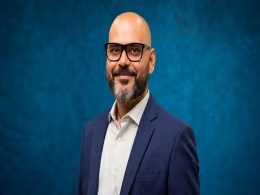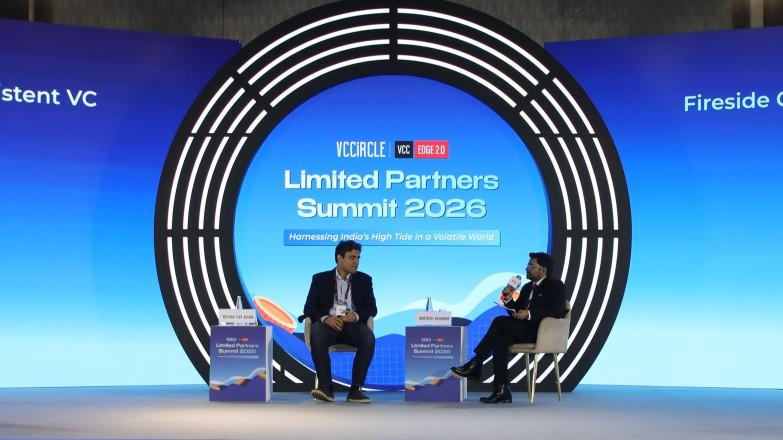
Consistency in venture capital is often judged not by a single successful fund but by the ability to survive multiple market cycles and continue launching new funds. At the LP Summit 2026 in Mumbai, Rehan Yar Khan, Managing Partner at Orios Venture Partners, discussed how venture capital strategies evolve over time and what it takes to engineer both alpha and early distributions for limited partners.
In a fireside chat with Anitesh Dharam, Business Head at VCCircle and VCCEdge, Khan spoke about the evolution of Orios’s investment strategy, the importance of investing after strategic pivots, and how sectoral shifts such as AI, defence indigenisation and manufacturing are shaping venture opportunities in India.
From intuition to repeatable venture investing
Reflecting on the evolution of his investing approach since the late 2000s, Khan noted that longevity itself is a key marker of success in venture capital. “There are very few funds that actually make it to Fund IV. I saw a statistic which said that only about 5 to 10% of funds globally get to Fund IV,” he said. Khan began investing after his own experience as a technology founder. While many aspects of venture capital evolve with experience, he said one core belief has remained constant.
“In venture capital, what is key is really the work that you can do with companies post-investment. The investment decision is only 20 to 30% of the work. The remaining 70 to 80% is what you do with the company after investing,” he said. Working closely with founders in the early stages is critical because startups often need hands-on support to navigate the complexities of building new businesses. However, one aspect of the firm’s strategy has evolved significantly over time: investing after companies undergo a strategic pivot.
Investing after the pivot
According to Khan, one insight that emerged over years of investing is that many successful companies undergo significant strategic pivots before reaching scale. “All the great companies in the world have pivots in them,” he said. He cited the example of SpaceX, which initially began as a launch company but now derives a majority of its revenues from its telecommunications business through Starlink. Khan explained that pivots often occur because founders enter industries where they initially lack deep experience. As they learn the nuances of the sector, they refine their strategy and reposition the business.“A pivot is actually the tuition that you pay for entering an industry,” he said.
This observation shaped Orios’s investment strategy. Rather than investing before the pivot, the firm increasingly prefers to invest after companies have already adapted their model. The approach also helps reduce risk. Global venture data, he noted, shows that Series A investments have about 75% mortality, while Series B investments still see around 50% failure rates. “That means there are a lot of false positives at A and B. What we are trying to do is avoid those false positives by investing post-pivot,” Khan said.
Building a fund structure for Indian LP expectations
Khan acknowledged that LP dynamics in India and Asia differ significantly from those in the US. American institutional investors often hold large portfolios of specialised venture funds, allowing them to diversify risk across early-stage and late-stage strategies. In contrast, many Asian LPs typically allocate capital to only a handful of venture funds.
“In Asia, LPs usually won’t have a large bouquet of funds in their portfolio. They will have only a few VC funds,” Khan said. As a result, funds operating in the region often need to balance both alpha generation and earlier distributions within the same vehicle. Orios addresses this by adopting a multi-stage strategy. In its earlier funds, the firm allocated a portion of capital to later-stage investments in its best portfolio companies.
“In Fund III we allocated about 20% of the corpus to crossovers - investing in our best companies from previous funds,” Khan explained. These investments typically involve more mature businesses that are closer to exit, helping stabilise the fund and generate earlier DPI. For the upcoming fund, the firm has expanded this allocation to around 30%, while the remaining 70% continues to follow the firm’s core alpha strategy.
“When you have 30% for crossovers and 70% for the alpha strategy, you end up with a very nice barbell strategy,” Khan said.
India’s opportunity in the AI application layer
Artificial intelligence was another major topic of discussion, particularly the role Indian startups can play in the global AI ecosystem. Khan outlined the layered structure of the AI technology stack. At the base are semiconductor chips, followed by large language models (LLMs), and then the application or agent layer built on top. He noted that the foundational layers of the AI stack are currently dominated by the United States and, to some extent, China. “Chips and LLMs have largely become a US play,” Khan said, citing the enormous capital requirements required to compete in these areas. Instead, he believes Indian startups are better positioned to innovate in the agentic AI layer, where companies build applications on top of existing models.
“These agents use multiple LLMs through APIs and combine them to deliver services—whether that is voice AI, content generation, legal services or other applications,” he said. The AI application layer also presents opportunities for companies to refine their business models as technology evolves. For instance, Khan noted that many voice AI startups initially focused on improving voice quality and emotional realism. But as the technology matured, the key metric shifted toward reducing the cost per call. “The big engineering pivot happened on the cost side,” he said, particularly when companies began targeting large call-centre markets where affordability is crucial.
Defence indigenisation creates new startup opportunities
Another sector attracting investor attention is defence technology, driven by India’s push for indigenisation. Khan described India as a country that faces ongoing geopolitical tensions, which has reinforced the need for domestic defence manufacturing. “The Indian military wants to do a lot of indigenisation,” he said. Defence programmes increasingly emphasise local production, with companies building capabilities ranging from drone systems and explosives to electronic warfare technologies. The push for domestic supply chains has also created opportunities for startups to manufacture components locally instead of relying on imports.
“There are companies now supplying parts that were earlier imported for foreign defence equipment,” Khan noted. As a result, the sector is witnessing rapid innovation and frequent strategic pivots as startups evolve from component suppliers into more integrated defence technology players.
The “Lenskart thesis” for hardware manufacturing
The discussion also explored Orios’s approach to investing in hardware and manufacturing startups, which Khan informally describes as the “Lenskart thesis.” The strategy is inspired by how eyewear company Lenskart built its manufacturing capabilities. Initially, the company imported eyewear products from China to test market demand and establish product-market fit. Once volumes increased, it began investing in domestic manufacturing capacity.“The founders identified that India did not have a strong domestic eyewear brand. They started by importing from China and once the volumes came, they started setting up factories here,” Khan explained.
This approach reduces early capital risk by allowing startups to validate demand before committing large investments in manufacturing infrastructure. “As volumes grow and prices need to come down, that is when the capex comes in,” Khan said. The model is now being replicated across multiple sectors where startups first test demand through imports before gradually shifting production to India.
FTAs and the rise of domestic manufacturing
The final part of the conversation addressed concerns around India’s recent free trade agreements (FTAs) and whether they might lead to a surge in imports that could hurt domestic manufacturing. Khan acknowledged that imports may initially increase as trade barriers fall. However, he believes India’s economic structure will eventually favour domestic production. India’s high purchasing power parity (PPP), which he estimated at around 3.5, means that once markets become large enough, local manufacturing typically becomes cheaper than imports.
“When a product’s market becomes large in India, it becomes cheaper to manufacture it here rather than import it,” he said. He illustrated this with the example of consumer products such as toothpaste: companies might initially import products to enter the market, but eventually local production becomes necessary to reduce prices and scale distribution. As trade agreements expand market access and supply chains diversify away from China, Khan believes India’s manufacturing ecosystem will continue to deepen. “The FTAs will bring in new products initially, but eventually those products will start getting manufactured in India,” he said.
About Orios Venture Partners
Orios Venture Partners is an early-stage venture capital firm focused on the India technology opportunity. The firm backs founders building in uncharted spaces across B2C, B2B, software and hardware, and typically invests in startups addressing the Indian market. Orios has been investing since 2008, first as private investors and then as Orios from 2013. The firm’s team combines entrepreneurial and operating experience, with a strong emphasis on working closely with portfolio companies on strategy, fundraising, people decisions and senior introductions.
Over the years, Orios has backed several prominent startups and describes itself as having been part of three unicorns and multiple scaled company journeys. The firm has launched multiple SEBI-registered funds, including Orios Venture Partners Fund, Fund II, Fund III and Orios Select Fund.