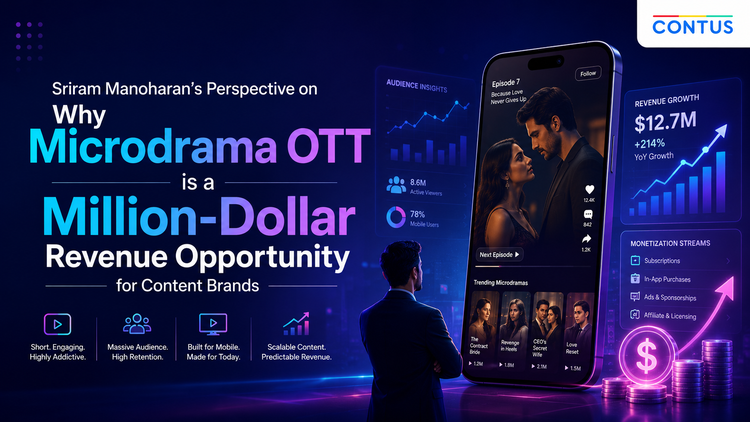
Over the past decade, Sriram Manoharan (Founder & CEO of CONTUS TECH) has seen the video streaming industry undergo a series of seismic shifts. Having worked closely with broadcasters, media companies and content businesses worldwide, while building VPlayed, a microdrama OTT solution, Sriram Manoharan has witnessed firsthand how audience preferences and content consumption habits continue to advance.
First came the rise of subscription video platforms and live streaming platforms. Parallel to this, there has been a growing demand for short-form content that is designed to be consumed first and foremost on mobile phones. Consequently, the digital entertainment scene has been changing at breakneck speed, barely giving us time to catch our breath.
Yet according to Sriram Manoharan, one of the things that is going to gain the most traction in the coming years is probably going to come from a category that many industry observers initially dismissed as a niche content format.
Microdrama - that is the category we are talking about. Microdramas evolved into a format that is built around short, vertically-formatted episodes, designed primarily for smartphone users. In fact, as we are talking here, microdrama has grown into a multi-billion dollar industry and showing no signs of slowing down as more people get comfortable with watching their favourite shows on their mobiles.
Beyond the staggering numbers, Sriram Manoharan believes that the explosive rise of microdrama signals a whole lot more than just a renewed interest in short-form storytelling.
| "Every major shift in media consumption begins when audience behavior changes faster than the industry expects. What we are witnessing with microdrama today is not a trend, but the emergence of a new entertainment category." - Sriram Manoharan |
Many discussions about microdrama keep looping back to the "short attention span" debate. But according to Sriram Manoharan, the way people are watching content has way more to do with a shift in viewing habits.
Smartphones have basically become the go to device for entertainment for millions of people around the world. And the way people consume content isn't just about sitting down in front of the TV on a specific schedule anymore; it rather snatching a few minutes here and there: on the daily commute, during a coffee break, or while waiting for something.
Let's be honest, it is happening everywhere in between and microdrama has been built specifically for this type of environment.
How Microdrama Fits the Way Audiences Watch Today
What makes microdrama particularly interesting, according to Sriram Manoharan, is its ability to deliver a compelling story in a way that doesn't require a large time commitment. Episodes usually run between 1 to 3 minutes, and long enough to keep the plot moving without needing to clear any kind of schedule. Viewers can easily consume 2 to 3 episodes in one go and still keep track of the story.
| "The industry often mistakes shorter content for simpler content. In reality, microdrama demands an entirely different approach to storytelling. Every minute must create emotional momentum and every episode must earn the next click." - Sriram Manoharan |
Why Content Brands Are Prioritizing Microdrama
Sriram Manoharan thinks that beyond attracting more viewers to the channel, it is the economics of microdrama that are making investors take notice. The traditional way of creating premium content is a slow and expensive process - years of development, a lot of money spent upfront and a hefty cost to get the product out to an audience.
But with microdrama, the rules of the game are completely different. You can get content out the door a whole lot faster, which means you get to know how your audience is reacting to your content much sooner. And that opens up a world of possibilities - you can scale up the hits and cut the underperformers before it is too late.
Now, you may think lower production costs are the biggest advantage, but that is not actually the case, it is the fact that you can learn quickly. You get to figure out what your audience is into a lot sooner and make better decisions about what to create next. And that is a precious thing in the entertainment industry where consumer tastes are always shifting; being able to try new things out and change direction on a whim is a huge asset.
Microdrama's Growing Influence on Content Consumption
Sriram Manoharan observes that a lot of people are still underestimating the impact of microdramas, because they are comparing them to the traditional video streaming platforms. He believes that is the wrong way to look at it. Microdrama is not attempting to compete with OTT platforms. What they are doing is actually creating a whole new way of watching content.
Social media platforms continue to dominate discovery and streaming platforms remain as a destination where you go to watch something from start to finish. Microdramas are what happens in between - shorter, more bite-sized stories that are just as engaging as anything you would find on any OTT platform, but much more convenient to fit into a busy lifestyle.
| "Every generation develops entertainment formats that align with how people interact with technology. Television defined episodic content. Streaming popularized binge watching. Microdrama is evolving as a storytelling format built specifically for the mobile generation." - Sriram Manoharan |
What Lies Ahead for Microdrama Over the Next 5 Years
Looking ahead, Sriram Manoharan anticipates that microdrama is about to get a lot more interesting in the upcoming months.
Advancements in artificial intelligence, personalized content recommendations, multilingual storytelling and audience analytics will all help drive the sector forward in a big way.
He also believes content brands will finally move past tentative experimentation with microdrama and start treating it as a proper business to invest in. The companies that succeed, however, won't just be the ones churning out more content. They will be the ones that genuinely get inside the heads of their audience and build real habits with them.
As more investment pours in and the microdrama category starts getting picked up all around the world, Sriram Manoharan sees microdrama moving from being an emerging format to a fully-fledged entertainment segment in the near future.