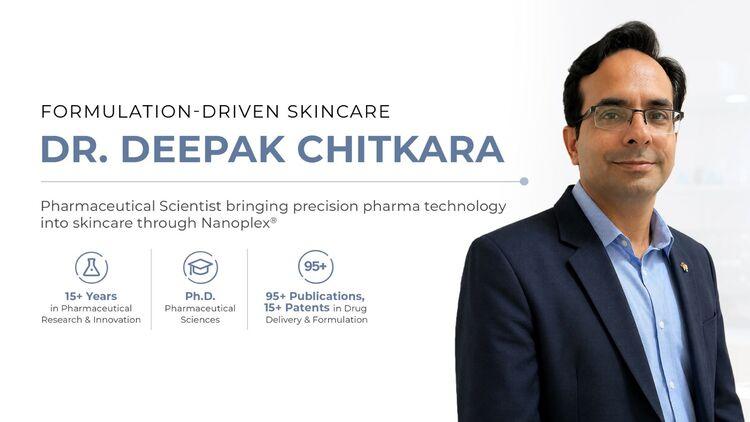
Skincare conversations are often dominated by trending ingredients, higher concentrations and ambitious marketing claims. Dr. Deepak Chitkara believes the industry’s real opportunity lies elsewhere—in understanding how ingredients are formulated, delivered and validated.
A professor at the Department of Pharmacy at BITS Pilani, with an M.S. (Pharm.) in Pharmaceutics and a Ph.D. in Pharmaceutical Sciences from NIPER, SAS Nagar, Chitkara has spent much of his career working at the intersection of drug delivery, nanotechnology and technology translation. He has applied this pharmaceutical-science approach to Inskin, a skincare venture built around the principle of using the right ingredient, at the right concentration, with the right delivery system.
Alongside Inskin, his ventures Zernyx and Cosmetolens are exploring how artificial intelligence, translational research and real-world evidence can help scientific innovations move beyond laboratories and become commercially viable products.
VCCircle Q1 : You’ve balanced an academic career with building two deep‑tech ventures. What was the moment you realised there was a commercial opportunity in the skincare space that science alone wasn’t addressing?
Dr. Deepak Chitkara : The realization came when I stopped looking at skincare as a cosmetic category and started looking at it through the lens of a pharmaceutical scientist.
My training and academic career have been deeply rooted in pharmaceutical sciences, where we're taught that the success of a product doesn't depend on the active ingredient alone. It depends on three equally important questions: Is it the right molecule? Is it present at the right concentration? And can it be delivered to the site where it needs to act?
In pharmaceuticals, we spend years optimizing drug delivery because we know that even the most effective molecule won't work if it doesn't reach its target. We also understand that more isn't always better. Every active has an optimal concentration—beyond that, efficacy may plateau while the risk of irritation or toxicity increases. We also routinely combine molecules to achieve synergistic effects, allowing us to deliver better outcomes at lower concentrations.
When I looked at the skincare industry, I realized the conversation was very different. Most discussions revolved around ingredients and percentages - "5% this, 10% that." Much less attention was being given to how those ingredients were delivered, whether they actually reached the part of the skin where they were intended to work, or how intelligently different actives could be combined.
That was the moment I realized there was a significant opportunity. The gap wasn't a lack of ingredients—we already have many excellent, scientifically validated actives. The gap was in applying pharmaceutical principles to skincare. That's how the philosophy of the Right Ingredient, the Right Concentration, and the Right Delivery was born. It became the scientific foundation of Inskin.
From there, we started asking a different set of questions. Instead of searching for the next trendy ingredient, we asked: Can we improve how existing actives are delivered? Can we create synergistic formulations that are more effective while remaining gentle on the skin? Those questions eventually led us to develop our Nanoplex® technology for peptide delivery and continue to shape our research today.
Looking back, I don't think the commercial opportunity was simply in selling skincare products. It was in bringing the rigor, discipline, and translational thinking of pharmaceutical science into an industry that has traditionally been driven far more by ingredients and marketing than by delivery science and systems thinking.
Q2. Inskin is built around the Formulation-First approach, something most consumers rarely think about. What sparked the idea of applying such advanced science to everyday skincare?
Before we talk about formulation, I think it's important to take a step back and look at the skin itself. We often think of skin as just the surface we see in the mirror. But biologically, it's one of the most sophisticated organs in the human body. It is our first line of defense, designed to protect us every single day.
The outermost layer forms a remarkably efficient waterproof barrier. Beneath it lies the living epidermis, where cells continuously communicate through intricate biological signaling pathways. On the surface exists another remarkable system—the skin microbiome, a diverse community of beneficial microorganisms that protects against harmful microbes, regulates inflammation, and helps maintain a healthy skin barrier.
When you start looking at the skin this way, you realize that skincare isn't simply about applying ingredients. It's about understanding and supporting a highly dynamic biological system.
In fact, if we remove all the scientific complexity, healthy skin really needs just four fundamental things. At Inskin, we summarize this through a simple philosophy we call HOPE- 'Hydration', 'Oil Balance', 'Protection', 'Ecosystem' :
Everything we develop at Inskin starts with these four pillars, how do we build products that actually support these four fundamentals?
This is where formulation science comes in.
I often say that formulation science isn't unique to pharmaceuticals - it's something we experience every day. Think about making a cup of tea. Two people can use exactly the same ingredients, yet the tea can taste completely different. Or think about two chefs cooking the same recipe with identical ingredients. One dish is exceptional, while the other is just average.
Why? Because it's not only what you use; it's how you put it together. The order of mixing, temperature, timing, proportions, and processing all influence the final outcome. That's formulation science.
The same principle applies to skincare.
Most conversations in skincare revolve around ingredients - retinol, niacinamide, peptides, vitamin C. But having a great ingredient doesn't automatically translate into a great product. Coming from a pharmaceutical background, particularly in advanced drug delivery and formulation science, I've seen this repeatedly. In medicine, the same drug can produce dramatically different outcomes depending on how it's formulated and delivered.
At some point, I asked myself a simple question: "Why should skincare be any different?" That question became the foundation of Inskin. Instead of beginning with a trending ingredient, we begin with the biology of the skin and then apply the principles of pharmaceutical formulation science to deliver those benefits effectively.
This naturally led us to our 3Rs philosophy—the Right Ingredient, at the Right Concentration, delivered in the Right Way. Because even the best ingredient won't perform if it's unstable, poorly formulated, or unable to reach the layer of the skin where it's intended to act.
That's what we mean by our Formulation-First approach. It isn't about making skincare more complicated. It's about making it more intelligent. We combine skin biology, and pharmaceutical formulation science, to create products that work with the skin rather than simply on the skin.
Q3. The skincare market is crowded and often confusing. From your perspective, what separates real, clinically grounded skincare from the usual buzzwords and marketing language?
The skincare industry has become incredibly good at marketing innovation. Every few months there's a new buzzword, a trending ingredient, or a promise of miraculous results. Marketing has an important role, it helps communicate value - but it should never replace science.
For me, the real differentiator is product innovation.
A clinically grounded skincare product begins with a simple question: Is there credible scientific evidence to support what we're claiming? From there, you look at whether the active ingredient is present at an effective concentration, whether it's stable in the formulation, whether it can actually reach the part of the skin where it's intended to work, and whether the final product has been validated. That's very different from simply highlighting a fashionable ingredient on the label.
I also think consumers have changed dramatically over the last decade. They're no longer satisfied with hearing that a product contains a trending ingredient. They want to know why it's there, how it works, and what evidence supports the claim. That's where I believe the next wave of innovation in skincare communication lies. The challenge isn't to invent more buzzwords—it's to make good science understandable. We shouldn't dilute the science; we should simplify the explanation.
At Inskin, that's exactly the approach we take. We focus on communicating the science in a way that's clear, honest, and easy to understand, while ensuring that every claim is supported by evidence. Because in the long run, consumers may buy a product because of marketing—but they stay with a brand because of trust. And trust is built on transparency, consistency, and products that genuinely deliver what they promise.
Q4. You often talk about the 3Rs (Right ingredient, Right concentration, Right delivery) How would you explain that philosophy to someone who just wants their skin to look better without understanding the technical side?
Most people don't buy skincare because they want to understand chemistry. They buy it because they simply want healthier, better-looking skin. The challenge is that many products focus on what's inside the bottle, but not on whether those ingredients can actually work on your skin.
That's why I talk about the 3Rs.
The Right Ingredient means choosing an active that has genuine scientific evidence behind it—not just something that's trending on social media.
The Right Concentration means using enough of that ingredient to deliver a benefit. More isn't always better. In fact, higher concentrations can sometimes increase irritation without improving results.
The Right Delivery is the part that's often overlooked. Even the best ingredient won't perform if it can't reach the layer of the skin where it's intended to work. That's where formulation and delivery science become just as important as the ingredient itself.
I often use a simple analogy. Imagine sending a parcel. You need the right item, in the right quantity, delivered to the right address. If it reaches the wrong destination, it doesn't matter how valuable the parcel is—it won't achieve its purpose. Skincare works in much the same way. So, for me, good skincare isn't about having the longest ingredient list or the highest percentage on the label. It's about getting the right ingredient, at the right concentration, to the right place in your skin. That's the philosophy behind the 3Rs—and it's the foundation on which we develop every product at Inskin.
Q5. Taking deep‑tech formulations from a lab bench to a commercial product is rarely straightforward. What were the unexpected hurdles you faced in scaling the science?
People often think that once the science works in the laboratory, the hardest part is over. In reality, that's when the real journey begins.
One of the biggest surprises was realizing that a formulation that performs beautifully in a controlled laboratory setting doesn't automatically become a manufacturable, stable, regulatory-compliant, and commercially viable product. Every stage introduces a new challenge. For us, it started with reproducibility.
Nanotechnology-based formulations are highly sensitive to processing conditions. A formulation prepared in a small research batch may not behave the same way when produced at a much larger scale. We had to redesign processes rather than simply increase batch size. The second challenge was balancing scientific performance with consumer experience. A formulation may demonstrate excellent efficacy, but if it feels sticky, pills under sunscreen, has an unpleasant texture, or isn't aesthetically appealing, consumers won't continue using it. Science has to work, but the product also has to delight the user. The third hurdle was regulatory and claims substantiation. As scientists, we're trained to communicate evidence carefully. In the commercial world, every claim must not only be scientifically accurate but also comply with regulations and be understandable to consumers. Bridging those worlds required a completely different mindset.
Finally, we learned that innovation isn't just about developing a better molecule or delivery system. It's about integrating formulation science, manufacturing, quality, regulatory strategy, intellectual property, consumer insights, and business considerations into one cohesive product. That experience fundamentally shaped how we work at Inskin. Today, we don't think of innovation as "bench to bedside" or "bench to market." We think of it as translation by design—building manufacturability, regulatory readiness, scalability, and commercialization into the technology from the very beginning, rather than treating them as problems to solve later.
Q6. Inskin now has more than 20 products. How did you decide what to build first? Was it data-driven, consumer-led or rooted in gaps you saw scientifically? Interestingly, we didn't begin with the most complex product—we started with what seemed to be the simplest: a hydration gel.
Our first product, the HA5 Deep Hydration Gel, taught us an important lesson. Hydration appears simple, but achieving long-lasting hydration without compromising skin feel or stability requires thoughtful formulation. It also gave us an opportunity to explore how different molecular weights of hyaluronic acid behave within the skin, laying the foundation for our approach to formulation science.
From there, we naturally moved into anti-ageing. To be honest, there was a personal motivation as well. As we ourselves entered the age where concerns like fine lines and skin ageing become more relevant, we wanted products that we would genuinely use. That philosophy has remained with us—we don't develop products simply because they're trending; we develop products that address problems we genuinely understand.
One area that particularly fascinated us was peptides. They are among the most well-researched and scientifically validated cosmetic actives available today. However, one of the biggest challenges is that many peptides struggle to reach the layer of the skin where they are intended to act. We saw this as an opportunity rather than a limitation.
That led us to develop our Nanoplex® technology, where peptides are complexed into proprietary nanocomplexes designed to improve their delivery. Instead of focusing only on which peptide to use, we focused equally on how to deliver it effectively. That delivery-first approach has become one of the defining principles behind our anti-ageing range.
As our portfolio expanded, the process became increasingly data-driven. We looked at recurring consumer concerns, identified areas where strong scientific evidence existed but better formulations were needed, and developed products that combined the right ingredient, the right concentration, and the right delivery. So, our journey has really been a blend of all three—it started with curiosity and personal need, evolved through scientific exploration, and today is guided by evidence, consumer insights, and innovative delivery science.
Q7. You often say skincare is becoming more biotech than cosmetic. What breakthroughs do you think are on the horizon - Peptides, Microbiome-based solutions, Protein delivery or something entirely different?
If we set marketing trends aside, I believe the next decade of skincare will be defined by two major revolutions—understanding the skin better and interacting with it more intelligently.
The first is diagnostics. For decades, we've classified skin into broad categories like dry, oily, or combination. But skin is far more dynamic than that. It changes with age, climate, stress, hormones, lifestyle, and even sleep.
Advances in AI, imaging, and data science are enabling us to measure skin much more objectively—hydration, barrier integrity, pigmentation, inflammation, wrinkle progression, and other biomarkers. As these technologies mature, skincare recommendations will become increasingly personalized, moving us away from generic routines toward precision skincare.
The second revolution is product innovation. We're moving beyond asking, "What ingredient should we use?" to asking, "How do we help that ingredient work better?"
Peptides are a great example. They are among the best-studied actives in skincare, but many are large biomolecules that struggle to reach the layer of skin where they're intended to act. That's why I believe the future isn't just about discovering new peptides—it's about developing smarter delivery systems that can transport them to the right depth and release them where they're needed. Delivery science will become as important as the active ingredient itself.
Beyond peptides, I see tremendous potential in microbiome-based skincare. We're beginning to appreciate that the skin isn't just a barrier—it's a living ecosystem. Future formulations will increasingly aim to support and modulate this ecosystem rather than simply treating visible symptoms.
Looking further ahead, I also believe we'll see advances in protein and other macromolecular delivery. Today, delivering these larger biomolecules through the skin remains a significant scientific challenge, but breakthroughs in nanotechnology, biomaterials, and carrier systems could eventually unlock entirely new classes of topical therapeutics and cosmeceuticals.
Ultimately, I think the biggest breakthrough won't be a single ingredient. It will be the convergence of diagnostics, biology, AI, and advanced delivery technologies. When we can accurately understand an individual's skin and pair that with formulations designed to work specifically for that biology, skincare will shift from being largely reactive and generalized to becoming predictive, personalized, and evidence-driven.
That's the direction we're working towards—combining formulation science, nanotechnology, and AI-powered skin intelligence to make skincare more precise, more effective, and ultimately more personal.
Q9. Your science is sophisticated but your customer base is broad. How have you managed to communicate something as complex as nanotechnology in a way that resonates with everyday consumers?
That's probably been one of our biggest challenges—and one of our biggest responsibilities.
Consumers don't buy complex science. They buy the confidence that a product will work for their skin. Our job is to translate complex science into benefits that are meaningful without oversimplifying or overstating the evidence. For example, instead of telling someone that we're using nanoplexes or advanced delivery systems, we explain that the active ingredient is delivered to the right depth of the skin, where it's intended to work. That's something people can immediately relate to.
The same philosophy applies across everything we do. Rather than overwhelming consumers with long ingredient lists or scientific jargon, we focus on answering three simple questions: What is the ingredient? Why is it there? And how does it help my skin? At the same time, we never compromise on scientific integrity. If the evidence supports a claim, we communicate it. If it doesn't, we don't make the claim. I believe today's consumers are far more informed than ever before. They don't necessarily want a lecture on science, but they do appreciate honesty, transparency, and explanations that make sense. Ultimately, our goal isn't to make consumers understand nanotechnology—it's to make them confident that there's robust science working behind the product, even if they never see the complexity behind it. That's how we build trust, and in science-led skincare, trust is just as important as innovation.
Q10. With Zernyx, you’ve moved into AI‑enabled tech for validating and commercializing innovations. How does this tie back to your work in skincare and nanoscience?
For me, Inskin and Zernyx are not two separate ventures—they're two parts of the same vision.
Inskin focuses on applying science to create products that improve people's lives. Zernyx focuses on building the ecosystem that makes more of those innovations possible.
At Zernyx, we work across two complementary verticals. The first is an AI-enabled technology translation platform that helps identify promising innovations and connect them with the right industry partners for commercialization. The second is Zernyx Labs, a translational R&D and piloting facility that helps improve the technology readiness of innovations through formulation development, scale-up, validation, and regulatory preparedness, particularly in healthcare and life sciences.
The idea came from a realization that many researchers share. Every year, universities generate remarkable technologies with real potential. At the same time, industries are actively looking for innovations they can adopt. Yet very few technologies successfully make that journey. The reason, in my view, is surprisingly simple. Academia and industry often speak different languages. One communicates through publications, novelty, and scientific rigor; the other thinks in terms of scalability, manufacturability, regulatory readiness, market need, and commercial viability. The technology isn't always the problem—the translation is.
That's the gap Zernyx is designed to bridge.
This philosophy directly influences our work at Inskin. When we develop a new skincare technology—whether it's a peptide nanodelivery platform or a novel formulation—we don't stop at asking, "Does it work?" We also ask, "Can it be manufactured consistently? Can it be validated? Can it meet regulatory expectations? Can it create real value for consumers?"
In that sense, Zernyx acts as the innovation engine behind Inskin. It brings together AI, translational research, nanoscience, formulation development, and commercialization to ensure that promising scientific discoveries don't remain confined to the laboratory. Ultimately, our vision is much broader than building skincare products. It's about creating a pathway where great science can consistently become meaningful, evidence-driven innovations that reach the people who need them.
Q 11. What should we expect from Inskin and your broader ventures over the next couple of years? Are you prioritising new research, category expansion, or scaling into new markets?
Over the next few years, our biggest focus won't be on launching the largest number of products—it will be on building better science behind every product we create.
A major area of our research is advanced delivery technologies. The skincare industry already has access to many well-established actives with strong scientific evidence. The challenge isn't always discovering new ingredients—it's enabling existing ones to reach the right location in the skin and perform more effectively. That's where we believe meaningful innovation lies.
Another exciting direction for us is skin microbiome science. We're beginning to understand that healthy skin isn't just about adding active ingredients—it's about maintaining the delicate ecosystem of microorganisms that naturally live on the skin. Our research is focused on developing delivery systems and formulations that help restore and maintain this balance, making skincare more adaptive and personalized rather than one-size-fits-all.
Alongside product innovation, we're also building Cosmetolens, because we believe the future of skincare depends as much on better evidence as it does on better formulations. Today, once a cosmetic product reaches the market, very little structured information is collected on how it performs in the real world across different skin types, climates, lifestyles, and routines.
In pharmaceuticals, we have pharmacovigilance, where real-world safety data is continuously collected, analyzed, and used to improve patient care. We believe skincare deserves a similar evidence-driven approach. Through Cosmetolens, we're building a platform where consumers can report not only adverse reactions but also product efficacy and outcomes, linked with their skin profile and usage patterns. Over time, this creates real-world evidence that can improve product development, bring greater accountability to the industry, and enable far more personalized recommendations than are possible today.
As we continue to strengthen our research, we also plan to expand into new product categories and new markets. But we'll do so with the same philosophy that has guided us from the beginning—science first, evidence first, and meaningful innovation over marketing trends. Ultimately, our vision is much broader than creating skincare products. We want to build an ecosystem where AI understands the skin, nanotechnology delivers the actives, biology guides the formulation, and real-world evidence continuously validates and improves every solution. That's how we believe skincare will evolve—from products that simply promise results to products whose performance is continuously measured, learned from, and refined.
Q 12. From an investor’s perspective, what kind of capital or strategic partnerships make sense for you at this stage? And how do you see the PE‑VC ecosystem fitting into the future of science-led skincare in India?
At this stage, our priority isn't raising capital—it's building the right strategic partnerships.
We're looking to collaborate with organizations that bring complementary strengths, whether that's advanced manufacturing, clinical research, dermatology networks, AI and data science, global distribution, or co-development of new technologies. We believe the right partnership can accelerate innovation far more effectively than capital alone.
Our philosophy has always been to build a strong scientific foundation first. Today, we have proprietary delivery technologies, an expanding portfolio of evidence-based products, AI-driven platforms like Cosmetolens, and translational capabilities through Zernyx. The next phase is about working with partners who share our vision of bringing science-led innovation to a much larger audience.
More broadly, I believe the PE-VC ecosystem has an important role to play in shaping the future of science-led skincare in India—not just by funding companies, but by encouraging long-term innovation. Deep-tech consumer healthcare businesses don't succeed through marketing alone. They require sustained investment in research, validation, intellectual property, and technology translation.
As the industry matures, I believe we'll see greater value placed on companies that own differentiated science, generate real-world evidence, and build defensible intellectual property. That's where the future lies.
For us, the vision extends beyond creating skincare products. Through Inskin, we're developing evidence-based formulations. Through Cosmetolens, we're building the real-world evidence layer for skincare by introducing cosmetovigilance and personalized skin intelligence. Through Zernyx, we're creating the infrastructure to translate scientific discoveries into commercially viable products.
Ultimately, we're looking for partners who want to help build that ecosystem—not just scale a brand, but help shape the future of science-driven skincare.
NOTE: For VCCircle Usage Only