
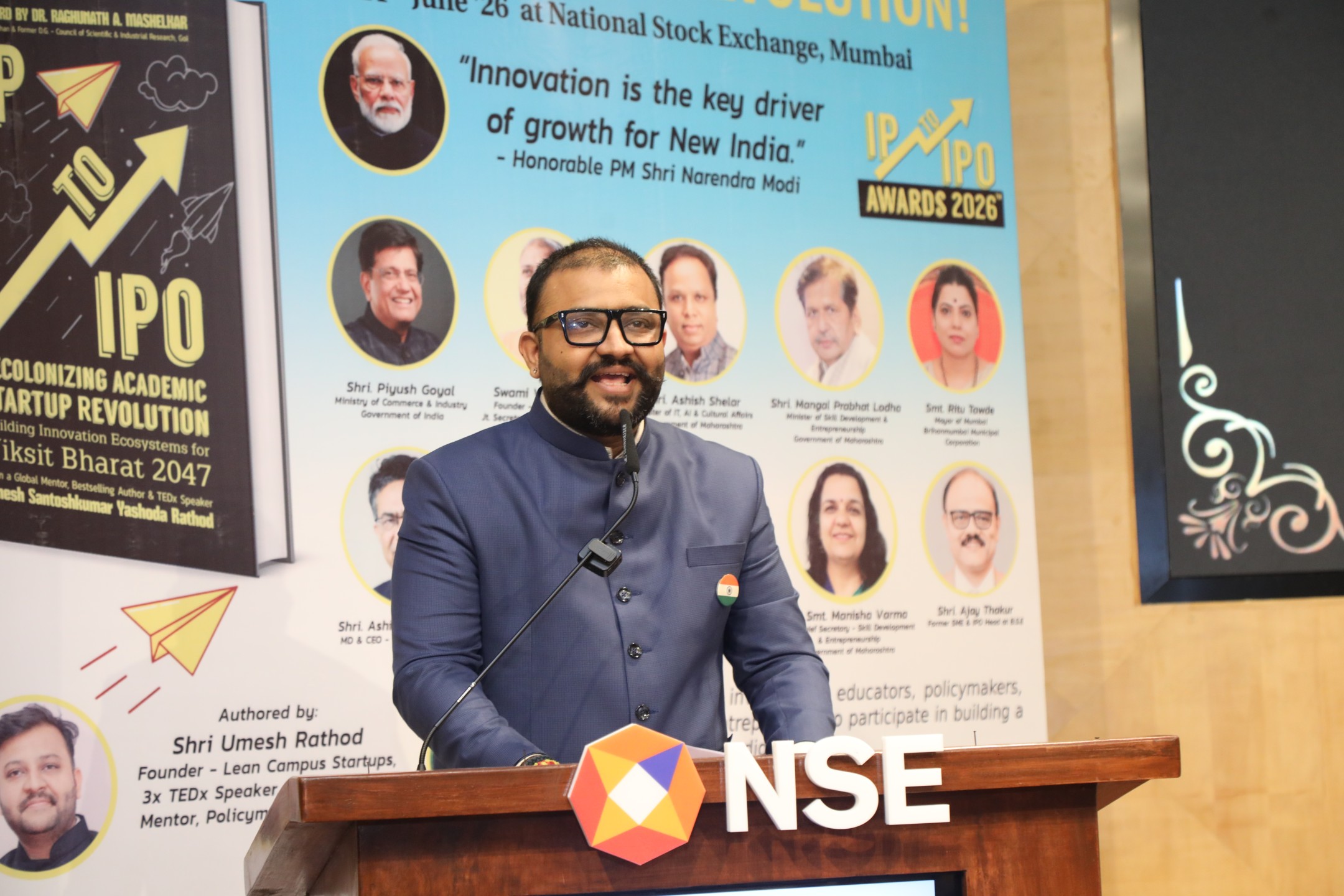
At a high-profile gathering at the National Stock Exchange, author Umesh Rathod officially unveiled his book, IP to IPO: Decolonizing Academic Startup Revolution - Building Innovation Ecosystems for Viksit Bharat 2047. The event brought together eminent policymakers, investors, academicians, and top dignitaries, including Chief Guest Shri Ashish Shelar Ji, Hon'ble Minister Shri Mangal Prabhat Lodha Ji, Smt. Ritu Tawde Ji, Padma Vibhushan Dr. Raghunath Mashelkar Ji, and Padma Vibhushan Prof. M. M. Sharma Ji.
Below is an exclusive adaptation of his address, structured as an in-depth interview exploring his vision to fundamentally transform India's academic and entrepreneurial landscape.
Interviewer: Welcome, Mr. Rathod. Your address today felt less like a conventional book launch and more like a call to action. What is the true intent behind this movement, and what core question are you posing to the nation?
Umesh Rathod: Namaskar. Today is not merely the launch of a book; it is the launch of a debate, a movement, and a national conversation that every university, faculty member, startup founder, investor, policymaker and student must have. The fundamental question before us is simple:
"Can Bharat become a developed nation by 2047 without becoming an innovation-led nation?"
My answer is a firm and unequivocal No. And that answer is the exact reason this book exists.
Q2. You have spent fifteen years interacting with lakhs of students, faculty, and innovators across Bharat. What specific observations led you to ask 'Why this book'?
UR: Wherever I travelled, one question kept troubling me. India is one of the world's largest producers of talent and engineers, one of the fastest-growing startup ecosystems, and one of the world's youngest nations. Yet, why are we still struggling to systematically convert knowledge into globally competitive enterprises?
I had to look closer at the contradictions in our current setup
• Why are we producing graduates but not enough creators?
• Why are we producing research but not enough commercialization?
• Why are we producing ideas but not enough global innovation champions?
• Why are we producing talent but not enough technology owners?
The answer lies in a missing bridge between academia and entrepreneurship, between research and markets, between patents and prosperity, and between intellectual property and enterprise creation. That bridge is what I call IP to IPO. The idea had been with me for years, but the final push came during a podcast conversation with Shri Ajay Thakur Ji titled 'A Journey to an IPO'. That conversation forced me to ask a bigger question: Why should the journey from idea to IPO remain the exception, and why can't it become a national system?
Q3. You spoke deeply about a civilizational shift rooted in Bharat's history. What do you mean by the journey 'From Saraswati to Lakshmi'?
UR: Every developed nation follows a predictable sequence: knowledge creates innovation, innovation creates intellectual property, intellectual property creates enterprises, enterprises create wealth and wealth creates national strength. In Bharat's own civilizational language, this is transitioning from Saraswati to Lakshmi.
For centuries, Bharat has worshipped knowledge. Now, the time has come to systematically convert knowledge into innovation, innovation into enterprise, enterprise into prosperity, and prosperity into national strength .This is no longer merely an economic agenda; it is our civilizational responsibility.
Q4. You didn't hold back when critiquing our current mindset, claiming that our academic institutions have boarded 'The Wrong Train'. Where did our priorities skew?
UR: Somewhere along the journey, we boarded the wrong train, and most of us did not even realize it. We entered a culture where one institution became famous because its students received the highest salary package, then another wanted a bigger package, and another chased an international package. Soon, it felt as though universities were conducting IPL auctions rather than building innovators!
We celebrated salary slips when we should have been celebrating solution builders. Nobody thought to ask HR departments or universities: How many patents? How many startups? How many technologies were commercialized? How many jobs were created? If colleges can proudly display the highest placement package on their websites, why can't they proudly display: '100 Patents Commercialized', '50 Startups Created', '10 Technologies Exported'.
The day that shift happens, Bharat's innovation story will change forever. The brightest minds of a nation should not only aspire to join great companies; they should aspire to build great companies.

Q5. India has established hundreds of startup cells and technology centers, yet you highlighted an 'Incubation Paradox', Why is there a disconnect?
UR: Many incubators openly tell me, "Sir, we have infrastructure. We have mentors. We have funding. But we don't have enough quality ideas." Why is that? Because the problem does not begin inside the incubator; it begins before it, inside our classrooms and curricula. We are still operating systems that continue producing consumers of opportunity instead of creators of opportunity. If innovation is not cultivated upstream, incubation cannot flourish downstream.
Let us look at our patent reality. India has more than 6.3 crore MSMEs, a young population, and a massive pool of engineers and researchers. Yet our intellectual property output remains well below our potential. Are our current improvements enough for a nation aspiring to become a developed economy? The question is not whether India is improving, but whether India is improving fast enough. The future belongs not to nations that consume technology, but to nations that own technology.
Q6. You emphasized that this movement is fundamentally a 'Jobs Imperative', How does shifting the focus of a university tie into solving the
employment crisis?
UR: At its heart, this discussion is not about patents, startups, or institutional rankings—it is about livelihoods, opportunity, and the future of young India. The world faces a massive employment challenge and governments, corporates and traditional industries cannot solve it alone. The sustainable answer lies in entrepreneurship, innovation, and enterprise creation.
Consequently, universities can no longer remain mere degree-distribution centres. They must become opportunity-creation centres, innovation centres, and enterprise creation centres. Every university should become an opportunity engine, every district an innovation district, every student given an opportunity to build and every incubator a job-creation laboratory.
Q7. You directly named faculty entrepreneurship as a major missing link. Why has this been historically restricted and how must the role of a professor evolve?
UR: For decades, faculty entrepreneurship was restricted, discouraged or deeply misunderstood. But entrepreneurship should never be associated with guilt. Entrepreneurship creates value, jobs, solutions and prosperity. In my earlier book, Startup Chanakya, I wrote: 'Udyamita Parmo Dharma'—Entrepreneurship is a noble duty. A nation that seeks prosperity cannot ask its creators to feel guilty about creating.
The professor of the future should not only publish papers. The professor of the future must create patents, startups, technologies, jobs, impact, and institutions. Let me pass a question to you that I asked the launch audience:
• How many of you know a student preparing for an entrance examination? Almost everyone.
• How many of you know a student preparing for a placement interview? Almost everyone.
• Now, how many of you know a student preparing to file a patent? Exactly. Total silence.
That is the vast gap this book explicitly seeks to address.
Q8. The subtitle of your book explicitly mentions 'Decolonizing Academic Entrepreneurship' . Why did you choose that word?
UR: Decolonization is not about the past; it is entirely about the future and establishing intellectual confidence. It is about moving from validation to imitation and finally to innovation; from dependency to true ownership. It means transitioning from being consumers of knowledge to creators of knowledge, and from job seekers to job creators. True decolonization means believing that Bharat can create globally relevant ideas rooted firmly in its own civilizational confidence.

Q9. You chose the National Stock Exchange (NSE) as your launch venue. Why was this setting so symbolic for the message of your book?
UR: There could not have been a better venue than the National Stock Exchange because this book traces an entire pipeline. It is about institutionalizing a journey from an idea in a classroom, to a patent, to a prototype, to a startup, to a scale-up, to an IPO, and ultimately to national prosperity.
I am incredibly grateful to the National Stock Exchange, all our partners, and most importantly to Padma Vibhushan Dr. Raghunath Mashelkar Ji, who graciously wrote the Foreword for this book. For decades, he has inspired India to believe in innovation, intellectual property, and scientific excellence. To have his vision shape my own and to receive his support is one of the greatest honours of my life.
Q10. To close our conversation, what is your ultimate call to action for the citizens of India?
UR: If you remember only one thing from today, let it be this: For the last 75 years, India largely measured success by how many people got jobs. For the next 25 years, India will be measured entirely by how many people create jobs. The question our youth asks must no longer be, "Which company will hire me?". The question must be, "What problem am I willing to solve?".
Let us move collectively from IP to IPO.
Jai Hind! Jai Bharat!
Book Link : https://notionpress.com/in/
Event Link : https://youtu.be/y7Q3o8QtIk4
Foreword Video: https://youtu.be/vvn7yUBA_CY