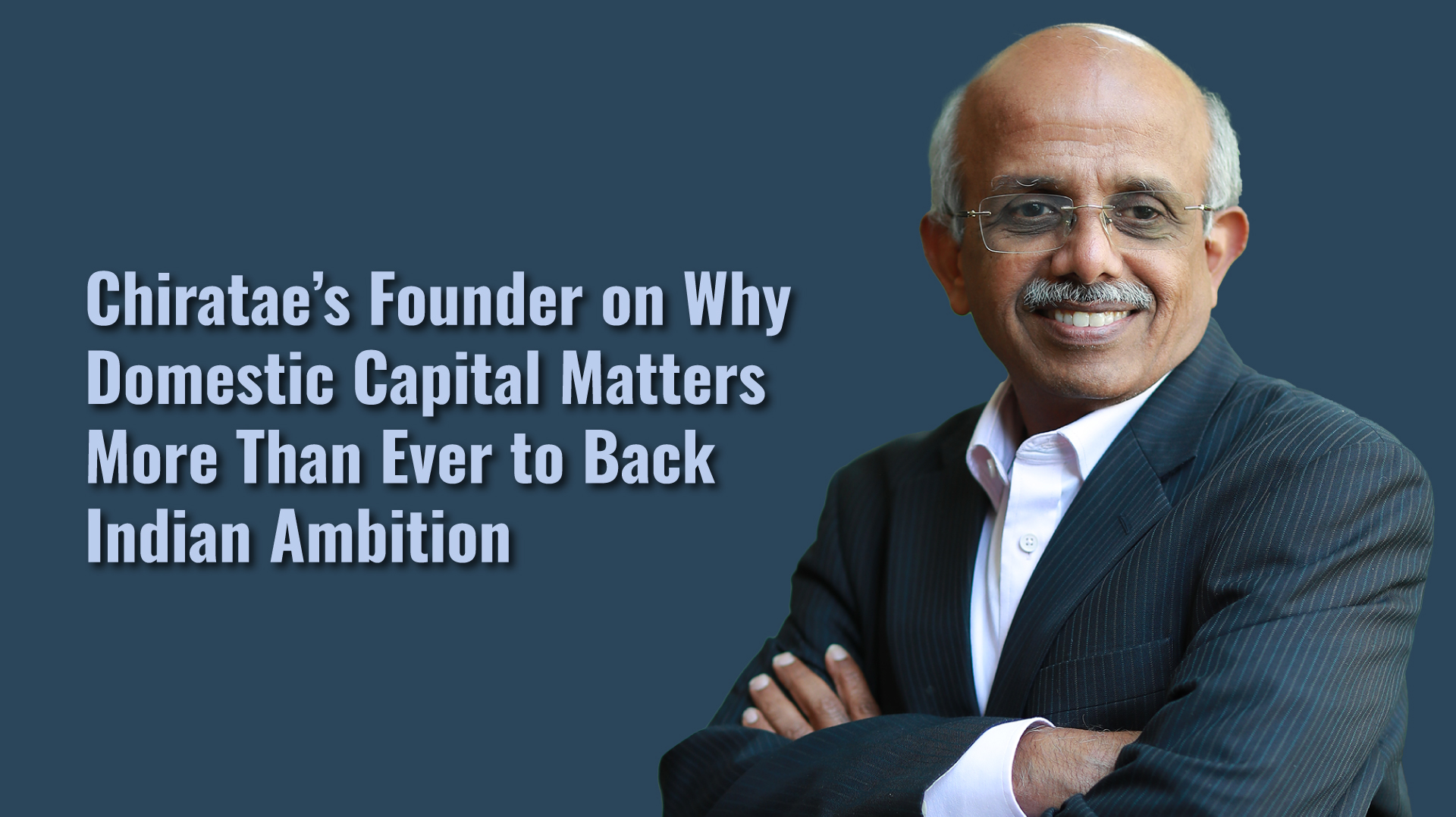
In this interview, T.C. Meenakshisundaram (TCM), Founder and Vice Chairman of Chiratae Ventures, reflects on the firm’s 18-year journey. From early bets on Lenskart, Myntra, and FirstCry to exits every year since 2012 and a strong push for domestic LP participation, TCM shares why domestic capital is crucial for backing Indian ambitions.
Q: Chiratae has been part of India’s startup story since the early days. Take us through the current shape and scale of the platform.
TCM: Chiratae Ventures was founded in 2006 with a long-term conviction that India’s future would be built on technology solving for scale. From our first fund of $150 million, we’ve grown to managing $1.3 billion AUM across seven funds and have made over 139 investments, with 57 active companies. What makes us proud is not just the scale, but the consistency of exits and returns.
We were among the earliest backers of brands that helped shape their categories-Myntra, FirstCry, Lenskart, Flipkart, and many more. Over the years, our thesis has expanded across ConsumerTech, SaaS, FinTech, HealthTech, DeepTech, ClimateTech, and AgriTech and we are actively looking at emerging sectors such as SpaceTech and Quantum. But the core is still the same: back long-term founders who use technology to disrupt the status quo building for tomorrow.
Q: Many funds talk about exits, but few have delivered consistently. How has Chiratae approached this?
TCM: We’ve delivered exits every single year since 2012. That’s a rare track record in Indian venture capital industry. Our cumulative exits and liquid assets are approaching the $1 billion mark. We’ve had four IPOs, two more DRHPs filed, and another five to six in the pipeline for the next 2-3 years.
Now, managing exits is about balance. It is very easy for a fund manager to fall in love with a company. However, you must balance maximising the outcome with ensuring liquidity is returned. You can’t exit too soon, but you also can’t hold on forever.
Q: You’ve been vocal about the need for domestic capital in venture. Why is that such a big theme now?
TCM: With technology getting weaponised in the geopolitical changes around the world, it is important for India to be able to own core technologies such as cyber security, semiconductors, quantum computing, AI foundation models and manufacturing. This is where domestic capital can play a significant role. In China, almost 60%+ of early stage capital was by domestic capital, and look at how China has significantly bridged the technology gap with the developed world including exceeding some of them.
VC investments in India represent just 0.05% of GDP—versus over 0.35% in the US. The gap is not just capital—it’s strategic capital allocation.
We believe domestic capital must participate meaningfully in this journey.
“You cannot not be in the alternative asset class. You can’t time the market. What it gives you is access to the future technologies which may not be available in the public markets.”
Whether it’s space tech or new-age AI companies, these are not yet listed. If you want exposure to India’s future leaders, private markets are the only way.
And within alternatives, there are many paths—VC, growth equity, private credit, and real estate. Some family offices we know are just starting out with allocations of 3–5%, while others have scaled to 30–35% in alternatives. What’s important is to start the journey based on your risk appetite.
Q: So you believe family offices should take more exposure to early-stage innovation?
TCM: Absolutely. If you believe India will go from a $4 trillion to a $40 trillion economy over the next 20 years—which is just 12% nominal compounding of GDP—then a part of that delta will come from companies that don’t even exist yet.
Just look at the BSE Sensex from 1994 to 2019. 23 of the 30 companies churned out by 2019. Only 7 remained. The next 20 years, Nifty 50 will have some companies not even born yet. If you want to ride that wave, you need to be in private markets today.
Q: What’s next for Chiratae and the broader Indian venture ecosystem?
TCM: We believe the next frontier is for Indian companies to go global while solving deeper India problems, especially in Tier 2 and 3 cities. We’ve seen that with Miko in Robotics, Pixis in AI-led marketing, and more coming through our portfolio.
At Chiratae, our Sonic program ensures speed and clarity at the seed stage, while our Growth Fund helps us double down at Series C and beyond.
But more than anything, we’ll continue doing what we’ve done for 18 years: back founders early, stay through their growth journey, and deliver value—not just in capital, but in governance, insight, and global readiness.
India’s innovation story is just beginning. We invite the Indian capital not just to watch it—but co-build it with us.
No VCCircle journalist was involved in the creation/production of this content.