As private markets grow more complex and global investors demand higher transparency, the role of asset service providers is evolving rapidly. Operational expectations from limited partners now extend far beyond traditional reporting, pushing fund managers to adopt new technologies and service models.
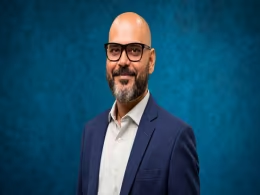
That shift was the focus of a fireside chat at the LP Summit 2026 in Mumbai, where Peter Hughes, Founder and CEO of Apex Group, spoke with Anitesh Dharam, Business Head at VCCircle and VCCEdge, about how asset servicing is changing and what it means for the GP-LP ecosystem.
From regulatory complexity to real-time data expectations and the rise of digital assets, Hughes argued that operational infrastructure is increasingly becoming a strategic component of fund management.
The rising role of asset service providers
Opening the discussion, Dharam noted that the asset servicing industry has evolved dramatically over the past two decades. Hughes agreed, pointing out that the increasing complexity of private markets has made it difficult for fund managers to operate without specialised service providers. “The world is becoming more complex,” Hughes said. “Traditionally people thought they could do this internally on Excel. That world is completely over.” He pointed to the aftermath of the global financial crisis as a turning point. The collapse of Bernard Madoff’s investment firm highlighted the risks of fund managers servicing their own funds without independent oversight.
“That really changed things,” Hughes explained. “People realised you need someone independently valuing assets and independently overseeing the money.” As regulatory requirements and reporting expectations have grown, asset service providers are now increasingly involved in enabling fund managers to meet those demands.
What LPs mean by operational excellence
When Dharam asked what LPs really mean when they talk about “operational excellence,” Hughes pointed to a clear shift toward transparency and real-time access to information. LPs today want much more than periodic reporting. “They want real-time data, faster valuations and the ability to analyse the data themselves,” Hughes said. Investors also expect valuations to be independently verified, which increases the importance of external service providers in the ecosystem. The demands vary depending on the type of LP, he added. A Canadian pension fund may require different reporting standards compared to a Dutch pension fund or a Middle Eastern sovereign investor. But the broader trend is clear: institutional investors increasingly expect sophisticated reporting tools. “Even family offices are becoming more sophisticated,” Hughes said.
He explained that earlier generations of wealth creators were satisfied with periodic updates, but newer generations expect detailed analytics and integrated portfolio views.
“They want attribution and analysis, not just a number saying the portfolio is up two percent,” he said.
GIFT City’s rise as a global financial hub
Another theme of the discussion was the rapid development of GIFT City as a financial centre. Hughes said he had initially compared GIFT City to other international financial zones such as DIFC in Dubai or ADGM in Abu Dhabi, but he now believes it could become even more significant. “It’s a much more powerful financial zone, both inbound and outbound,” he said.
One factor driving its growth is the tax structure. Hughes pointed out that GIFT City offers significant advantages at a time when global tax rules are tightening. “Globally you’re seeing minimum tax regimes of around 15 percent,” he said. “GIFT still has a zero percent structure.” Combined with strong regulatory backing and growing infrastructure, the ecosystem is expanding quickly. Apex currently employs around 250 people in GIFT City, and Hughes expects the jurisdiction to become one of the firm’s fastest-growing markets. “We think it could become a top ten global financial jurisdiction within five years,” he said. The demand from asset managers is also rising rapidly. Many firms that previously structured funds through Mauritius or Singapore are now exploring GIFT City as an alternative.
Beyond fund administration
Traditionally, fund administrators have been associated with services such as NAV calculation and reporting. But Hughes argued that the role is expanding into a broader end-to-end service model.
“Fund administration has become somewhat of a commodity,” he said. Instead, differentiation increasingly comes from technology and the ability to transform data into actionable insights. According to Hughes, the key value lies in helping asset managers distribute products to a broader investor base.
“If you can transform the data so that people can invest with smaller ticket sizes, greater transparency and better liquidity, then you’re making a real difference,” he said. One major trend is the democratisation of private markets. Traditionally, institutional investors dominated private market funds with minimum ticket sizes of $5 to 10 million. Today, asset managers are exploring ways to make these products accessible to a wider set of investors. Hughes cited the example of large global firms seeking to raise substantial capital from wealth and retirement portfolios rather than purely institutional channels. “That shift means private markets are becoming accessible to investors with much smaller minimum investments,” he said.
Digital assets and tokenisation
Hughes stressed that digital assets should not be confused with speculative cryptocurrency trading. “People often mix up crypto and digital assets,” he said. While unregulated cryptocurrency markets can carry risks related to transparency and anti-money laundering compliance, digital assets represent a broader infrastructure layer for financial markets. One example is the rapid growth of stablecoins. “Tether alone has around 550 million wallet holders and is adding about a million new users every day,” Hughes said.
As regulatory frameworks mature and institutional infrastructure develops, these technologies could transform how investment products are distributed. “We see digital assets as new rails for fund access,” he said.
AI, automation and the future of fund operations
Artificial intelligence is also expected to reshape how asset managers operate. Hughes noted that many fund managers are already deploying AI tools to improve portfolio analysis and operational efficiency.
From a GP perspective, AI can reduce reliance on junior operational staff while enhancing analytical capabilities. “A lot of firms are already thinking about how AI can help manage portfolios better,” he said.
However, he stressed that AI is unlikely to reduce employment overall. Instead, the nature of roles will evolve. “Your job won’t be taken by AI,” Hughes told the audience. “It will be taken by someone who knows how to use AI.”
Apex itself is investing in AI-driven tools to enhance the services it provides to clients. The company currently employs around 13,000 people globally, including 6,000 in India, and Hughes said the firm plans to expand its workforce by focusing on talent with strong technology and data skills.
A future of always-on markets
Looking ahead, Hughes believes technological change will eventually reshape how investment markets operate. Advances in tokenisation and blockchain infrastructure could allow investment products to process large volumes of investors far more quickly than traditional systems. “You could have fifty thousand investors entering a fund in a single day if the infrastructure is on-chain,” he said. Over time, he expects markets themselves to operate for longer hours, potentially even continuously. Major exchanges such as Nasdaq and the New York Stock Exchange are already extending trading hours, and Hughes believes the shift toward always-on markets will continue.
“That will fundamentally change how investment products are designed and distributed,” he said. In that environment, asset service providers will play a critical role in enabling fund managers to adapt to new distribution models and investor expectations.
About Apex Group
Apex Group is a global financial services provider founded in 2003 in Bermuda by Peter Hughes. The firm offers a broad range of services across fund and asset servicing, supporting asset managers, allocators, financial institutions, and family offices worldwide. The company operates a unified, single-source platform that spans the entire asset lifecycle, combining fund administration, corporate services, custody, depositary, and digital solutions. Apex emphasises technology-enabled infrastructure and cross-jurisdictional expertise to support the evolving needs of global investment managers. Today, Apex Group has more than 13,000 employees across over 100 offices in 52 countries and services approximately $3.5 trillion in assets globally.