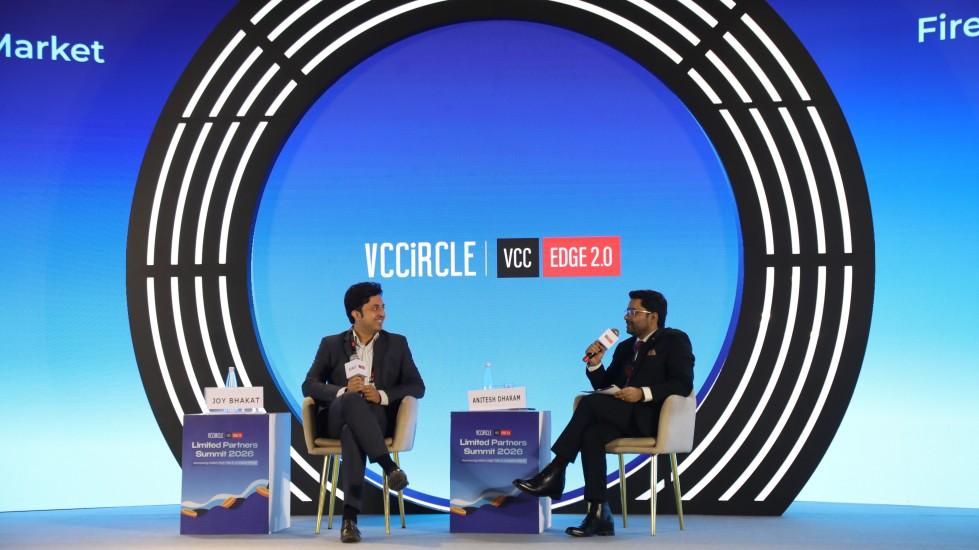
India’s venture ecosystem is entering a phase where the conversation is shifting from startup creation to building companies that can sustain in the public markets. That theme was at the centre of a fireside chat at the LP Summit 2026 in Mumbai, where Joy Bhakat, Co-Founder and Head of Investments at Steadview Capital Management, spoke with Anitesh Dharam, Business Head at VCCircle and VCCEdge, about the evolution of India’s venture landscape and what it takes to build the next generation of public-market champions.
Drawing on Steadview’s experience investing in India for nearly two decades, Bhakat outlined how the ecosystem has matured and why venture-backed companies are increasingly finding a viable pathway to the public markets.
The ecosystem has finally found its foundations
Reflecting on the early years of venture investing in India, Bhakat said the ecosystem lacked some of the essential building blocks required for startups to scale sustainably. “In any venture ecosystem, three things need to come together - talent, risk capital, and a playbook of successful companies,” Bhakat said.
While India has long had a deep pool of engineering and technical talent, the broader ecosystem needed time to evolve. Today, he noted, more young professionals are willing to stay back and build startups in India rather than move abroad, while venture funding has also expanded significantly. Equally important is the emergence of visible startup success stories. Companies such as Zomato, Nykaa, Policybazaar and Lenskart have become large listed businesses, creating role models for the next generation of founders. “Five or ten years ago, there were very few domestic champions that founders could look up to. Today that has clearly changed,” he said.
From copying global models to solving India-specific problems
Another shift Bhakat highlighted is the changing nature of Indian startups themselves. In the early part of the last decade, many startups were effectively trying to replicate successful global models in the Indian market. Today, however, more founders are building companies designed around India’s unique consumer behaviour, infrastructure gaps and regulatory landscape. “That has created businesses for which there may not even be a direct global comparison,” he said.
At the same time, some Indian companies are increasingly expanding internationally. Bhakat pointed to companies such as Lenskart and Urban Company as examples of businesses that have successfully extended their footprint beyond India. He also noted the growing appetite among founders to pursue deeper technology bets, including areas such as space tech, defence and healthtech. “We are also seeing young founders building satellites, drones and other deep-tech products. That kind of ambition was far less visible earlier,” Bhakat said.
India’s IPO market is becoming a credible exit pathway
The conversation then turned to IPOs, which have historically been considered a weak point for venture exits in India. Bhakat acknowledged that global investors had long viewed exits as a challenge for private market investing in the country. But in his view, the last few years have begun to change that perception. “Five years ago there were only about 10 listed new-age companies with a combined market cap of around $20 billion. Today there are about 45 companies with a combined market cap of roughly $165 billion,” he said. Even with that growth, new-age companies still account for only about 3% of India’s total market capitalisation, compared with roughly 30-35% in the US and 20-25% in China. “That tells you how much headroom still exists,” Bhakat added.
Another difference between India and the US lies in the scale required for listing. While US tech IPOs often require companies to reach much larger revenue levels, Indian companies can go public at a relatively smaller scale as long as they have credible economics and visibility on profitability. The recent trend of startups redomiciling back to India, he said, reflects growing confidence in domestic public markets.
What founders must get right before going public
While IPO opportunities are increasing, Bhakat emphasised that public-market success ultimately depends on strong business fundamentals. “The most important thing for a successful listing is strong fundamentals backing the business. Everything else is secondary,” he said. He outlined four key factors founders should focus on well before initiating the IPO process.
The first is long-term growth visibility. Public investors want to see a clear pathway for sustained growth, often supported by multiple business lines or growth engines. The second is profitability. Markets today are far less tolerant of companies that rely purely on revenue growth without demonstrating viable unit economics. The third is predictability. Bhakat noted that founders transitioning from private to public markets need to change their mindset. “In public markets you need to under-promise and over-deliver. That’s how credibility gets built,” he said.
Finally, pricing discipline is critical. Founders should ensure IPO valuations leave sufficient upside for incoming investors. “Leaving money on the table for new investors creates a positive experience and builds long-term trust in the market,” he said. Narrative matters, but numbers matter more. Beyond execution metrics, the discussion also touched on the role of narrative in public market success. Bhakat argued that storytelling can amplify investor interest, but only if the underlying numbers are strong. “If the numbers are not good, then no narrative can help you. But if the fundamentals are strong, a strong narrative can definitely magnify the story,” he said.
Preparing that narrative should begin long before the IPO itself. Founders, he said, should start engaging public-market investors early so that the market has time to understand the business and track its performance. He also emphasised the importance of governance and operating discipline. “Some companies begin behaving like public companies even while they are still private. That builds credibility with investors,” Bhakat said.
Capturing value earlier in the venture cycle
The final part of the discussion focused on how investors can capture the value being created by India’s startup ecosystem. Bhakat noted that many companies today stay private for longer than they did in the past, meaning a significant portion of value creation happens before listing. That dynamic has shaped Steadview’s strategy of focusing on late-venture opportunities, where companies already have strong economics but still retain meaningful growth potential. “We are leaning into the late-venture opportunity in India,” Bhakat said.
He highlighted several sectors where the firm sees long-term potential, including AI-driven enterprise services, high-end manufacturing, consumer brands and fintech. Across these areas, he said, India is benefiting from structural trends ranging from global supply-chain shifts to rising digital adoption and changing consumer behaviour. “We are very excited about what lies ahead in India,” Bhakat said.
About Steadview Capital Management
Steadview Capital Management is a global investment firm founded in 2009. The firm follows a crossover investment strategy, making concentrated, long-term investments across both public markets and private companies, with a strong focus on technology-driven and founder-led businesses. The firm follows a long-term, research-driven investment approach and invests across both public and private markets, with a focus on technology-enabled and founder-led businesses.
Headquartered in London, Steadview operates globally with offices in London, San Francisco, New York, and Mumbai. The firm partners with companies across sectors such as technology, consumer, financial services, and industrials, typically making concentrated investments and supporting businesses through multiple stages of growth.
Since its inception, Steadview has invested in more than 50 private companies globally and has backed several prominent technology and consumer businesses in India, including companies such as Zomato, Nykaa, Policybazaar, Lenskart, Delhivery and Freshworks.