India’s family offices are increasingly examining how decisions are made as second, third and fourth generations prepare to enter businesses and question wealth structures created by earlier generations. The central challenge is often not a choice between preserving tradition and accepting change, but a reluctance to introduce formal structures that may be perceived as limiting control.
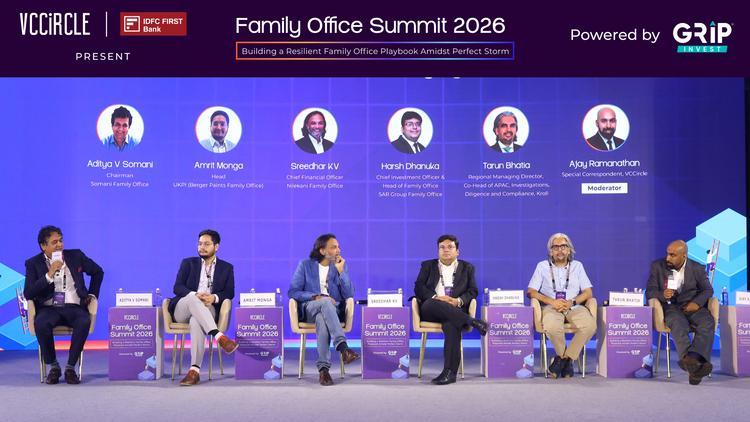
Speaking at the VCCircle Family Office Summit 2026, Tarun Bhatia, Regional Managing Director and Co-Head of APAC, Investigations, Diligence and Compliance at Kroll, shared his assessment of where family offices commonly go wrong, why hiring professionals is not the same as professionalizing decisions, and what the family offices navigating generational transition effectively tend to have in common.
The Real Resistance Is to Structure, Not to Change
Mr. Bhatia argued that the obstacle is not necessarily a contest between honoring tradition and accepting change, but a reluctance to be governed by a formal structure.
“Most family offices that we work with are resistant to a structure because they feel they lose control if they implement structure,” he said.
That resistance compounds over time, he noted, because the second, third and fourth generations in many businesses are likely to enter the business eventually but do not spend sufficient time on it beforehand. Kroll, he said, works with family offices in their early days as they put together an investment structure, conducts diligence when they evaluate potential investments, and stays involved as they approach exits.
Confusing Legacy with Governance
The first of the pitfalls he identified is a conflation of legacy with governance. Most family offices are accustomed to a decision-making process run by the patriarch or the first-generation founder, and they are unable to let that go.
A defined structure, he said, helps a family articulate what that process actually is, which in turn gives the next generation something concrete to either relate to or move forward from. Ideally, Governance should institutionalize principles, not personalities.
Waiting for an Event to Force the Transition
The second mistake is the tendency to treat generational transition as something triggered by circumstance rather than planned for.
“In India, we often wait for events. We wait for a particular age, we wait for a demise, whereas it should be far more natural if the next generation is interested,” he said.
Exposing the next generation to the business and to the family’s way of doing things much earlier would help, he said, and it does not happen as often in India as it should.
Hiring Professionals Without Handing Over Decisions
The third pitfall applies to family offices that have brought professionals into their organizations but have not changed the way decisions are made.
“Family offices hire experienced executives, yet key decisions remain informal or family-driven,” he said. “This creates ambiguity, weakens accountability, and makes it difficult to attract and retain top talent.”
Culture Is Not the Same as Compliance
The fourth challenge is an assumption that the culture in which a business was built is itself a substitute for ethics, compliance and governance. He said it is not.
“What worked 20 years back may not work today and will not work 20 years later,” he said, adding that families remain focused on creating wealth while being reluctant to change the governance mechanism built around it.
“The most successful family offices don’t choose between preserving tradition and embracing change. They preserve their values while evolving their governance. That’s what enables wealth—and legacy—to endure across generations.”
Defining the Non-Negotiables
Asked what actually works, he was clear that no single model applies.
“I don’t think there’s a formula. Each family will find what works for them,” he said, adding that continuity and change are not competing forces.
The family offices that seem to be doing well, in his experience, are those where the first generation is not preoccupied with preserving its own legacy. They did what they had to do, he said, and the next generation now needs to take it forward in the way that works for them.
What helps that handover, he said, is for a family to define its non-negotiables and distinguish between values that should never change and practices that should.
For example, long-term stewardship and integrity may be non-negotiable, whereas asset allocation, technology adoption, or impact investing should evolve with the times. A simple Family Constitution or Charter can make these distinctions explicit and avoid future disagreements.
Letting the Next Generation Actually Decide
Picking up on a reference another panelist had made to the traditional Munimji, Mr. Bhatia noted that the role was about tracking things rather than contributing to the decision-making process. The next generation, he said, wants to be a decision-maker.
If a family wants its wealth managed by the next generation, that generation needs to feel it holds a genuine decision-making role, which makes clearly assigned accountability and responsibility essential. Rather than waiting for succession, one should involve younger family members early through governance roles such as observers on the investment committee, leading family’s ESG initiatives, or participate in philanthropy boards. This builds competence while bringing fresh perspectives without disrupting decision-making.
Professionalize governance with clear decision rights
The above applies to the professionals now entering family offices, who he said are increasingly upfront about asking what authority they will hold. Families need to set ground rules, but if they insist on being involved in every decision, defining the investment committee and reviewing every proposal, the process fails, particularly as the business grows larger and more complex.
Monitoring Governance as Closely as the Balance Sheet
He closed with a point that, in his experience, often gets missed.
“Monitor your governance structure as often as you monitor your bank balance or your wealth,” he said.
Families focus heavily on what is happening to their wealth, he added, without putting in place the guardrails that protect it.
As a closing comment he said “Families often believe their greatest asset is their wealth. In reality, it’s their ability to make good decisions together across generations. The family offices that endure are those that institutionalize trust through governance, while creating space for each generation to shape the future.”
About Kroll
Kroll is a global financial and risk advisory firm that helps organizations address complex matters involving valuation, governance, transactions and risk. The firm combines specialist expertise, data and technology to support clients in making critical financial and strategic decisions. The firm traces a history of close to a century and today employs roughly 6,500 specialists in over 30 countries and territories. It counts six of every ten Fortune 500 companies among its clients and is headquartered in New York, with offices worldwide.
Its capabilities are organized into three broad service areas: Financial Advisory, Risk Advisory and Business Services. Financial Advisory includes valuation, alternative asset advisory, transaction advisory, real estate and fixed asset advisory, investment banking, tax and transfer pricing services. Risk Advisory covers areas such as investigations and diligence, cybersecurity, compliance and regulation, enterprise security risk management, expert services and restructuring. Business Services provides complex administrative solutions, including agency and trustee services, issuer services, restructuring administration and settlement administration.
NOTE: This article has been developed by the VCCEdge Research Team for Kroll.