Gold has long been an important part of Indian household wealth, held in the form of jewellery, coins and bars etc. As allocations become large investors will have to consider practical issues around storage, security, liquidity, pricing and transferability.
NSE Electronic Gold Receipts, or NSE EGRs, are designed to address some of these concerns by allowing standardised physical gold to be represented electronically and traded through a regulated exchange framework.
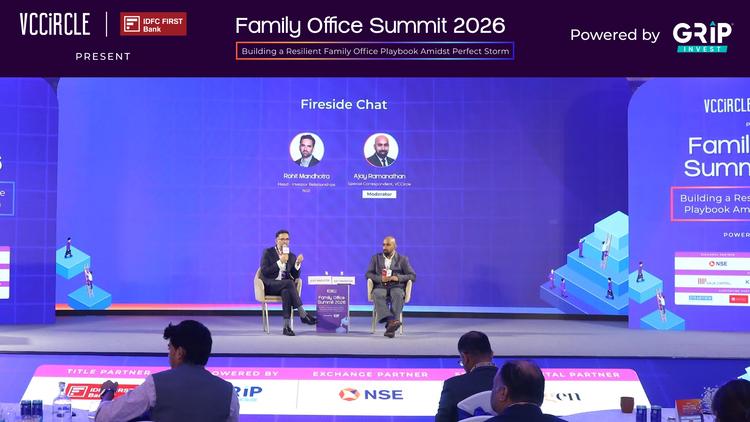
At the VCCircle Family Office Summit 2026, Rohit Mandhotra, Head - Investor Relationships at the National Stock Exchange, discussed the evolving role of EGRs and their relevance for investors looking to hold gold in a more structured form.
What Is an Electronic Gold Receipt?
An EGR is a security representing ownership of physical gold stored within a regulated vaulting ecosystem. SEBI approved the framework for a Gold Exchange in 2021, with Electronic Gold Receipts designated as the instrument representing the underlying physical gold. EGRs were subsequently recognised as securities under the Securities Contracts (Regulation) Act.
Unlike products that only provide financial exposure to gold prices, EGRs are backed by eligible physical and standardised gold deposited with registered vault managers. Once created, the receipt is credited into the investor's demat account which can then be traded on a recognised stock exchange or converted back into physical gold, subject to the applicable specifications.
How the EGR Framework Works
The ecosystem brings vault managers, depositories, stock exchanges and clearing corporations together.
Eligible physical gold is deposited with a SEBI-registered vault manager and verified against prescribed purity and quality standards. Once accepted, the corresponding EGR is created and credited to the beneficial owner's demat account through the depository system. The process can also work in reverse. An investor can surrender the EGR and request delivery of physical gold, after which the corresponding electronic receipt is extinguished. This ability to move between physical and electronic ownership is a key feature of the framework. Standardisation is equally important. Gold used for creating EGRs must conform to recognised standards prescribed under the regulatory framework. NSE currently offers EGR in various denominations with 995 and 999 purity gold.
The framework also provides for fungibility, which means an EGR is not permanently tied to the specific serial-numbered bar originally deposited. Equivalent eligible gold can be delivered when an investor converts the EGR back into physical form, subject to the prescribed conditions.
Trading Gold Through an Exchange
NSE commenced live trading of Electronic Gold Receipts in May 2026. The exchange provides EGR products across different denominations and purity levels, allowing participation to trade across varying investment sizes. Trading takes place through an electronic order-driven market, with orders matched on price-time priority. Transactions are settled through the exchange’s clearing house infrastructure, while the EGR itself continues to be held in dematerialised form. NSE's EGR segment currently follows a T+1 settlement cycle.
For investors, this creates a mechanism through which gold can be held alongside other securities in a demat account and transacted without requiring the underlying metal to move every time ownership changes.
Why the Structure Matters
The logistical challenges associated with physical gold tend to become more relevant as the size of the holding increases. Large holdings may involve costs and processes related to storage, security, insurance, transportation and physical verification. Selling physical gold can also require investors to approach individual dealers or jewellers, where pricing may vary.
EGRs do not change the underlying exposure to gold, but they change how that ownership can be maintained and transferred. Exchange trading provides a market-linked price for a standardised instrument, while the underlying gold remains within a regulated vaulting system.
An Emerging Spot Gold Market
EGRs are also part of India's broader effort to develop a more organised spot gold market. Historically, the country's gold market has been fragmented across jewellers, bullion dealers and regional markets. The EGR framework introduces common standards around eligible gold, vaulting, ownership records, exchange trading and settlement.
NSE's launch of the segment in 2026 expands this infrastructure, but the market remains at an early stage. Liquidity will depend on sustained participation from investors, bullion traders, refiners, jewellers and other institutions. As the segment develops, trading volumes, market depth and the ease with which investors can enter or exit positions will be important indicators of adoption.
Where EGRs Fit
EGRs are unlikely to replace traditional forms of gold ownership, particularly jewellery, which has cultural and consumption value. Investors also have several other ways of gaining exposure to gold. Their relevance lies in offering another structure through which standardised physical gold can be held electronically, traded through an exchange and converted back into bullion. For family offices and larger investors, this shifts the discussion beyond how much gold to own. It also raises a second question: how should that allocation be held and transacted?
As India's spot gold market evolves, EGRs provide one framework through which physical ownership and securities-market infrastructure can increasingly converge.
NOTE: This article has been developed by the VCCEdge Research Team for NSE.