
A record month of corporate issuance, a sovereign curve 26 basis points higher, and a Federal Reserve back in tightening mode — all before the Monetary Policy Committee meets on 7 October.
September was the busiest month of the financial year so far at India's primary bond window, and it was busy for a reason. Borrowers spent the month pulling funding forward while the sovereign curve repriced under them and the world's largest central bank resumed raising rates.
A record month at the primary window
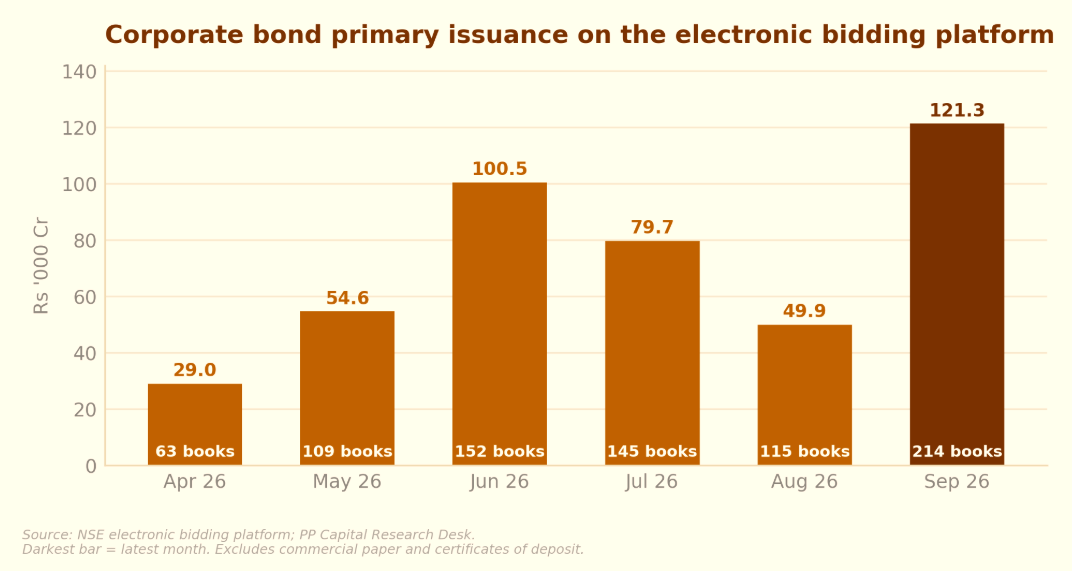
Indian companies raised Rs 1,21,290 crore through 214 bond issues on the NSE electronic bidding platform in September, across 136 issuers. That is roughly two and a half times August's Rs 49,930 crore and comfortably ahead of June's Rs 1,00,468 crore, the previous high of the year. The figures exclude commercial paper and certificates of deposit.
Reliance Industries alone accounted for Rs 25,000 crore across two books: Rs 12,000 crore of five-year paper at 7.47 per cent on 15 September, and Rs 13,000 crore of ten-year money at 7.89 per cent on 30 September. REC raised Rs 7,500 crore across three tranches, SIDBI Rs 5,889 crore of three-year paper at 7.70 per cent, and Delhi International Airport Rs 3,500 crore of fifteen-year debt at 8.71 per cent. The credit mix stayed conservative. AAA-rated paper made up 67.2 per cent of the month's value and AA+ a further 10.9 per cent, with everything rated A+ or below accounting for under 4 per cent. The story of September was volume, not a broadening of risk appetite.
The sovereign curve moved first
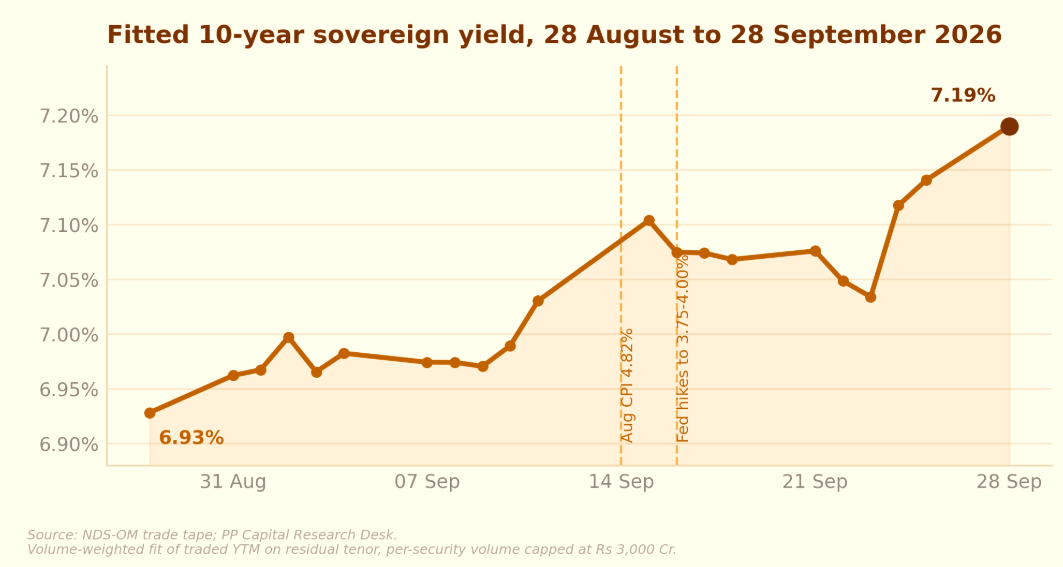
The cost of that funding did not stand still. A volume-weighted fit of the NDS-OM trade tape puts the ten-year sovereign yield at 7.19 per cent on 28 September against 6.93 per cent a month earlier, about 26 basis points of repricing. Most of it arrived in two steps: after the August consumer price print on 14 September, and again through the final week of the month as positioning ahead of the policy meeting hardened.
The Federal Reserve turns hawkish
On 16 September the Federal Open Market Committee raised the federal funds target range by 25 basis points to 3.75-4.00 per cent in a unanimous vote, its first increase since 2023. US consumer prices had risen 0.4 per cent in August against 0.1 per cent in July, taking the annual rate to 3.4 per cent, with core inflation at 2.4 per cent. The committee's own projections put the median federal funds rate at 4.1 per cent at the end of both 2026 and 2027, and sixteen of eighteen participants saw room for at least one further increase this year. For Indian issuers, a firmer global rate path narrows the window in which long-dated funding can be locked cheaply.
What October holds for the RBI
The Monetary Policy Committee last met in August, holding the repo rate at 5.25 per cent with a neutral stance, raising its FY27 growth forecast to 6.7 per cent and trimming its inflation projection to 5.0 per cent. The data since have pushed the other way. Consumer price inflation rose to 4.82 per cent in August from 4.44 per cent in July, with food inflation at 5.95 per cent, against a backdrop of firm crude and the weakest southwest monsoon in more than a decade. The RBI's own August projection already had inflation averaging 5.9 per cent in the third quarter of FY27.
Consensus has moved accordingly, and now looks for the repo rate to be raised to 5.50 per cent at the 7 October meeting. Growth gives the committee room to move: output in the June quarter expanded 7.8 per cent year on year, ahead of the RBI's own 7.0 per cent projection for the quarter, which leaves inflation rather than activity as the binding constraint.
The key takeaway
Primary issuance is a forward-looking indicator, and September's Rs 1.21 lakh crore says treasurers have already concluded the easing cycle is over. The sovereign curve agrees, having moved 26 basis points before the committee has said anything. If the RBI does raise on 7 October, the decision will confirm a repricing the market has largely completed rather than initiate one. The question worth watching is not October, but whether December follows — and whether the issuance window that stayed open all September stays open into the second half of the financial year.
NOTE: This article is prepare by PP Capital Research Desk
Insights Focus is a marketing initiative for sponsored posts. No VCCircle journalist was involved in the creation of this content.