
Connecting a model to a market used to mean a custom connector, a credential store, a hand-rolled scope model and a compliance review. That work has largely collapsed into a server registration, an authentication redirect and a set of permission toggles, while credential security,
testing and compliance review remain separate responsibilities.
The difficulty did not disappear. It moved from the connection into the permission model and permission models fail quietly.
The Connection Is the Easy Part
For most of the past two years, giving a model the ability to act on an external system meant building the integration twice: once for the capability and once for the authorization, then repeating both for every model provider a team wanted to support.
A standardized connection layer removes the first half of that work and leaves the second half exactly where it was. That is worth saying plainly, because the marketing around agent tooling tends to imply otherwise.
The Binance implementation follows the shape now common across the protocol. An agent registers the Binance MCP server against a documented endpoint, authenticates from the user's account, and is assigned a dedicated Agentic sub-account whose permissions the user sets. Compatibility is documented for Claude, Claude Code, Codex, ChatGPT, Cursor and VS Code.
One scoping detail matters more than the setup steps. MCP support currently covers trading and market data only. Payments and on-chain activity are reachable through other Agent OS components and are slated for MCP in later releases, so the connection layer and the capability
layer are not yet the same size.
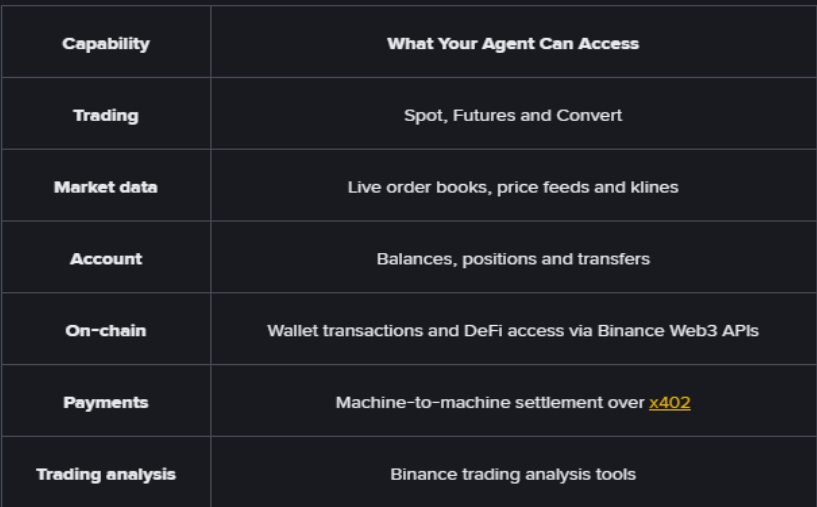
"Agent OS brings those capabilities together through tools like MCP, Skill Hub and Agentic Wallet", says Jeff Li, VP of Product at Binance, "giving developers flexible ways to build."
Flexibility is a real benefit and a real hazard and optionality only helps if the same permission semantics hold across every path a developer picks. If you guarantee that across an exchange API, a wallet and a payment rail becomes a harder engineering problem than exposing a shared endpoint.
What the Perimeter Refuses
The design principle underneath all of this is unglamorous: an agent should never be the last line of defense against its own failure. The failure mode that matters in agentic finance is authorized misuse, where every credential is valid and the instruction is wrong.
System prompts, fine-tuning and tool descriptions shape how a model reasons. None of them is a security boundary. A well-placed prompt injection can move an agent outside its intended behavior while leaving its credentials untouched. The published attack literature describes this
as a chain with distinct hijack and persist stages where an attacker first forces tool calls with chosen parameters and then embeds payloads that survive into later sessions.
The defense that has emerged across enterprise deployments is a policy layer beneath the agent. This includes spending limits and counterparty allowlists as well as transaction-type restrictions and time windows along with escalation thresholds. The model can’t override these because none of them live inside it. Compliance-grade implementations add audit logging and preserved approval chains so every agent action generates a record a reviewer can reconstruct afterward. Security researchers have also named the governance failure that shows up when this is skipped, describing teams standing up servers with access to sensitive systems entirely outside any review process.
Agent OS applies a version of that pattern. Scopes cover market data, account information, trading and internal transfers, with no withdrawal scope available. An agent cannot pull funds from the main account; the user moves capital in manually.
Every asset-changing transaction fires a push notification. Transactions scored as high risk are routed to the user for confirmation rather than executed or rejected automatically, and an emergency stop revokes every connected agent at once.
The design goal, Li says, is "allowing users to define what an agent can do and keeping actions transparent and auditable", on the premise that agents "need the same reliable data, infrastructure and controls that users and developers expect today."
The Limits That Are Not in the Feature List
Four constraints deserve attention before anything is funded. For exchange trading, Binance applies no separate cap on how much an agent can trade or lose. The sub-account balance is the effective ceiling, which makes the funding decision the primary risk control and argues for caution before enabling leveraged products.
The Agentic Wallet enforces its own daily limits, documented at launch as $50,000 for regular swaps, $100,000 for DeFi transactions and $20 for x402 payments. Those are daily caps rather than per-transaction ones, a meaningful difference for anything running at high frequency.
The reasoning is not observable. Binance states that an agent's decision-making happens on the user's machine or inside the chosen AI application so resulting trades can be monitored while the logic behind them cannot. Availability also varies by location and account status as
well as product eligibility.
Beyond any single venue, the specification itself is worth reading before trusting a connector. MCP requires OAuth 2.1 with PKCE for remote servers, has moved toward Client ID Metadata Documents and enterprise-managed authorization, and removed protocol session requirements in its July 28, 2026 revision, which changed how servers scale behind a load balancer. Those properties should be verified rather than assumed.
What a Good Refusal Tells You
Any agent financial stack looks capable in a demo. The useful evaluation is what it declines to do when the instruction is wrong, and how much of that refusal is enforced somewhere the model cannot reach. Standardized connection layers have removed most of the engineering friction from reaching a venue. What remains is the access control, and that is now the part worth spending review time on.
NOTE: No VCCircle Journalist was involved in the creation of this content.