SEO used to have a relatively clear job. Make a website technically sound, understand what customers search for, create useful content, build authority and compete for the right positions on Google.
None of that has stopped mattering. What has changed is everything being built around it.
Search results now coexist with AI Overviews, conversational assistants and generative answers. Customers can discover a company without following the traditional path from keyword to search result to website. They can ask an AI system to compare vendors, explain products, shortlist agencies or recommend a solution. For businesses, particularly enterprises, this creates a practical problem. They cannot afford to abandon conventional SEO, but neither can they prepare for the next five years using a search strategy designed entirely around the last fifteen.
This is the gap ThatWare, the India-origin search intelligence company founded by Tuhin Banik, has been positioning itself to address.
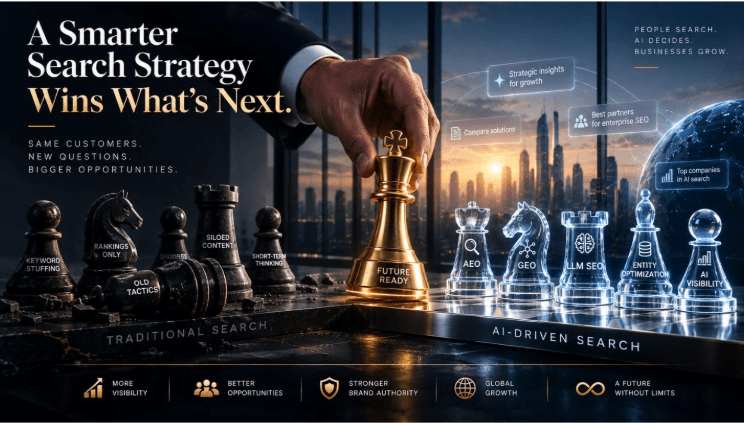
Its proposition is less about declaring the death of SEO and more about expanding what a modern SEO company is expected to understand: technical SEO, enterprise SEO, AI SEO, Answer Engine Optimization (AEO), Generative Engine Optimization (GEO), LLM optimization, entity intelligence and AI visibility measurement.
That combination offers an interesting indication of where the search industry may be heading.
The old SEO playbook is no longer the whole playbook
For a business choosing an SEO company, conventional capabilities remain non-negotiable. Websites still need to be crawled and indexed efficiently. Architecture matters. Search intent matters. Content needs purpose. Internal links need logic. Authority needs to be built rather than manufactured. Organic traffic still needs to translate into enquiries, pipeline or revenue. But consider how a buyer might now research a service.
One person searches Google for “enterprise SEO services.”
Another asks an AI assistant: “Which SEO companies can handle a large international website and also improve visibility across AI search?” The business requirement is essentially the same. The route to discovery is different. An SEO agency built solely around ranking webpages may be well equipped for the first journey but less prepared for the second.
ThatWare's response has been to treat AI-driven discovery as an extension of the search discipline rather than a separate marketing channel. In practical terms, that means protecting what already works in SEO while developing capabilities for the environments appearing around it.
A modern SEO company increasingly has two customers
Every business ultimately optimizes for people. But between the company and those people now sits an increasingly sophisticated layer of machines interpreting information. Search engines crawl it. Ranking systems evaluate it. Knowledge systems connect it. Large language models interpret it. Generative engines may retrieve, summarize or compare it. That changes what optimization involves.
A page can be technically optimized and still leave uncertainty about the organization behind it. A company can rank for a keyword while its services, expertise or market position remain poorly understood in an AI-generated answer.
This is one reason ThatWare has placed entity optimization alongside traditional SEO.
A business is not simply a collection of URLs. It is a network of relationships involving products, services, people, expertise, locations, research, industry associations and independent references. Making those relationships clear is becoming part of making the business discoverable.
AEO, GEO and LLM SEO are not replacements for SEO
The industry's expanding vocabulary can make this transformation sound more complicated than it needs to be.
Answer Engine Optimization (AEO) concerns how effectively information can satisfy questions and answer-oriented experiences.
Generative Engine Optimization (GEO) addresses how information and brands can be understood and represented in generative search environments.
LLM SEO considers discoverability and representation where large language models participate in the research journey.
These disciplines overlap with SEO because they depend on many of the same fundamentals: accessible information, authority, relevance, clarity and trustworthy evidence. This is an important distinction in ThatWare's approach.
Rather than separating conventional SEO from AI search, the company has been developing them as layers of the same search intelligence stack. For businesses evaluating an AI SEO company or an SEO agency in India, that integration may matter more than adopting any individual acronym. The requirement is increasingly for continuity: rank today while building the information architecture, authority and machine understanding required for tomorrow.
Enterprise search raises the stakes
The transition becomes more consequential at enterprise scale.
A large organization might have tens of thousands of URLs, multiple countries, languages, subsidiaries, products and content teams. Different parts of the organization can describe the same capability in different ways. Managing this is already a demanding enterprise SEO problem. AI systems add another consideration: consistency of understanding. If a company's product descriptions, corporate information, expertise and external references tell conflicting stories, machines have to resolve those inconsistencies. ThatWare's work increasingly treats this as both a search problem and an entity problem.
Its Vector Entity Model (VEM) explores relationships between organizations and their associated attributes and entities. The objective is to make those relationships clearer rather than treating every webpage as an isolated SEO asset. This is where next-generation SEO starts looking considerably different from simply tracking more keywords.
Ranking first doesn't answer every question anymore
There is another issue businesses will eventually have to confront: measurement. Suppose an enterprise ranks strongly for its most important Google searches. Its marketing dashboard looks healthy. Then its customers begin asking AI systems for recommendations, and three competitors repeatedly appear while the enterprise does not.
What metric reveals that problem?
Traditional ranking reports were never designed to answer it. ThatWare has been working on this question through AI Visibility Metrics (AVM), its framework for examining dimensions such as presence, citations, authority, consistency and positioning in AI-driven discovery.
AVM and VEM address different sides of the same challenge. VEM is concerned with how clearly an entity and its relationships can be represented.
NOTE: No VCCircle Journalist was involved in the creation of this content.
Insights Focus is a marketing initiative for sponsored posts. No VCCircle journalist was involved in the creation of this content.