Two Metainventions share one scale from 0 to 1. The 0→1 Doctrine checks AI actions against approved limits before they run, a step towards superintelligence safety. Band-Based Archive Triage (BBAT), filed 23 September and 1 October 2026, sorts dormant archives by metadata. Among its many features, Dark Data Monetisation Without Exposure (DDME) could let holders earn, and privacy-tested Band-Derived Training Signals (BDTS) could help AI past the data wall. This text focuses primarily on BDTS.
THE WALL AHEAD
Researchers warn that the supply of high-quality public text may run short, and that training on machine-made text risks model collapse. Yet a vast share of records sits in archives, unused and too sensitive to copy. That is the data wall. Of the many features in both inventions, BDTS meets it most directly.
THE 0→1 DOCTRINE, IN FULL
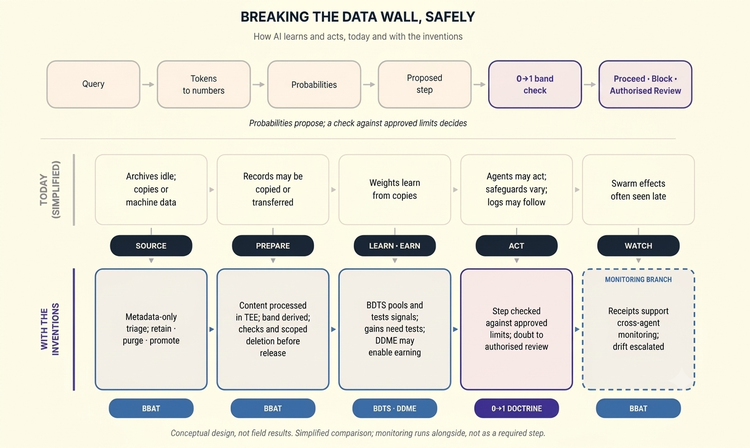
Each measurable need, resource and limit is mapped to a band between 0 and 1, using its own reference range, so meaning is kept. A chain of tokens links a request to a supplier. Inside the approved band, an action proceeds; outside, it stops; when unsure, a person decides. A sealed receipt records it.
BBAT, IN FULL
Band-Based Archive Triage reads only metadata, never content, and sorts each record: retain, purge or promote. Purging what no rule requires could cut storage bills; legal holds go to Human Override.
Promoted records enter a TEE, a sealed hardware vault, where a band is derived; sources are then destroyed in declared scope. A Cross-Agent Aggregation Detector (CAAD) reads sealed receipts, flagging combined risks.
THE AXIOM AT THE CORE
The IN-VAULT DERIVATION AXIOM sets strict conditions in two phases. Before a band exists, it checks one-way derivation, work inside the TEE, a minimum group size, a minimum band width and the risk from outside data. Afterwards, it confirms the source is destroyed and that tests could not rebuild any record. Any failed condition holds release.
HOW AI ANSWERS A QUESTION
Type a question and a model splits it into small pieces called tokens, each turned into a list of numbers. Trained on vast text, it works out the probability of every possible next piece, picks one, and repeats. An answer is a chain of likely words. Fluent means probable, not checked.
PROBABILITY, NOT PROOF
A model can be confident and still wrong; that is one way invented facts appear. An agent is a model given tools: it chooses each step by likelihood, then books, pays or changes code. Permissions and sandboxes help. What is often missing is a measured limit, approved in advance and recorded before the step is taken.
WHY 0 AND 1 CAN WORK
Probability already lives between 0 and 1, a scale machines already use. Any measure with a reference range, from voltage to dosage, can be placed on it. A band rather than a single point carries honest uncertainty. Same inputs under the same rule give the same answer, every time.
WHY 0 AND 1 ALONE CANNOT
Without a reference range there is no band. Intent, fairness and ethics resist measurement, so they go to a person. Wrong inputs produce wrong bands, and a band blurs fine detail. A model's confidence of 0.9 is not a band of 0.9. The Doctrine sends what numbers cannot settle to people.
WHAT BDTS DOES
BDTS, Band-Derived Training Signals, accepts bands, not records, from many sources. Its intake is designed to refuse any band lacking a hardware attestation certificate, and carries no identity, raw value or device code. An aggregator pools the bands without keeping which source sent which, while sealed receipts preserve an evidence trail for auditors.
FIVE WAYS TO READ A CROWD
From the pool, BDTS can read five things: how values spread, how two measures move together, how patterns persist, where groups cluster, and how far a population drifts. The method is chosen in a fixed order: regulation, data shape, declared purpose, then domain authority. Builders still test each signal's value.
TESTED BEFORE IT TRAVELS
Before a package leaves, BDTS is designed to attack its own output, trying to rebuild records, spot whether one person was included, and reverse the transformation. A failed test holds the package. A passing one is sealed with a receipt naming population bracket, privacy result, package and method. Testing lowers risk; it cannot erase it.
EARNING WITHOUT EXPOSURE
DDME, Dark Data Monetisation Without Exposure, lets a data holder offer bands derived inside its own vault instead of selling records. Purged records could cut storage bills and breach exposure, while promoted ones could earn. The filing creates the option to monetise and leaves pricing to markets. Value would rest on what buyers can measure.
WHERE PEOPLE STAY IN CHARGE
In BBAT, a legal hold or low-confidence case goes to Human Override first. In the Doctrine, what bands cannot settle goes to a named reviewer. Drift detectors escalate; they do not act alone.
WHAT SAFETY MEANS HERE
Safety here does not mean teaching a model good values. It means two lines drawn outside the model: what it may learn from, and what it may do. Those lines are designed to hold as a model grows smarter, because they live in vaults, gates and receipts, not in its weights. They complement other safety work.
THE AGENT, AFTER
An agent still plans freely. When it proposes a step, the Doctrine maps relevant conditions to bands and compares them with approved limits. Authorisation follows only a fit; orchestration then tracks the step and can pause or reroute it. A receipt is sealed at decision. Across agents, BBAT detectors read receipts and flag drift.
WHO COULD GAIN FIRST
Archive-heavy hospitals, banks, telecoms and governments could cut storage and exposure and open a revenue option. Model builders could gain permitted signals with lineage; regulators, receipts to inspect. Each gain would need measuring.
QUICK ANSWERS
| Must both inventions be used together? | Each works alone; joined, they govern learning and action |
| Is BBAT useful without AI training? | Yes. Sorting alone can trim storage and exposure; BDTS, DDME and CAAD are equal paths beside it. |
| What does CAAD add? | It reads sealed receipts across many agents, flags when actions allowed one by one add up to risk, and escalates to people. |
CLOSING NOTE
Intelligence will not wait. But what it learns, and what it does, can still be measured, sealed and held within lines we drew.
LIVE : www.0to1doctrine.com . This can be tested, live, via API, governed against ungoverned, side by side.
THE INVENTOR : Systems theorist, inventor and entrepreneur Vatsal Soin holds granted patents in the US, Japan, India and more; filings span six continents. His August 2026 grant covers AI footwear with Sharable Size Card (SSC). His inventions span AI apparel with Global Biometric Size Card (GBSC), digital twins, robotics, global data, quantum resilience and governance. SIM–RMIT and NTU alumnus. Every invention was a step; 0→1 is the destination.
SELECTED REFERENCES
Granted: US Patent 12,446,652 B2 · Japan Patent 7560909 · India Patents 454081 and 599317. Filed: PCT/IN2025/051943 · US 19/489,595 · India 202511115781 · Australia AU2022450649 · India 202611113867 (23 September 2026) · PCT/IN2026/052042 (1 October 2026).
Insights Focus is a marketing initiative for sponsored posts. No VCCircle journalist was involved in the creation of this content.