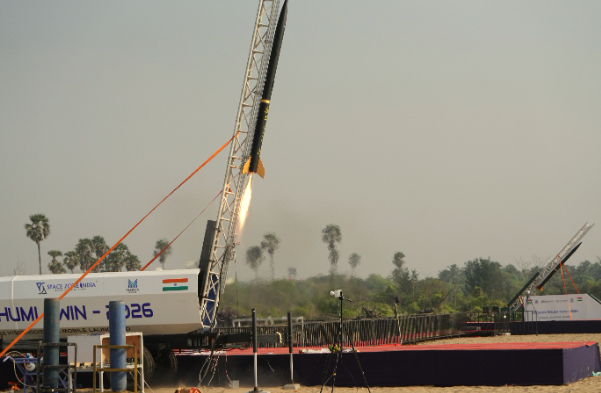
Chennai-based aerospace company demonstrates mid-air reignition of its RRR-1 hybrid rocket, opening possibilities for reusable launch systems, fuel-efficient propulsion and future commercial space applications.
Chennai, October 12, 2026: In a significant development for India's emerging private aerospace sector, Chennai-based Space Zone India Private Limited has reported the successful demonstration of in-flight rocket engine restart technology through its RRR-1 (RHUMI Restart Rocket) during Mission RHUMI TWIN 2026, conducted on October 10 along the Thiruvidanthai coastline near Chennai.
The experimental mission was designed to evaluate the ability of a hybrid rocket engine to shut down during flight and subsequently reignite, a capability that could support the development of advanced propulsion systems for future space missions.
Rocket Completes 9–3–5 Second Restart Sequence
According to Space Zone India, RRR-1 underwent a programmed three-stage operational sequence during flight. The engine initially generated thrust for nine seconds, after which the propulsion system was intentionally shut down for three seconds. During this interval, the rocket continued travelling along its trajectory without powered propulsion.
The engine was then reportedly restarted for an additional five seconds, completing a 17-second flight sequence comprising 14 seconds of powered operation and three seconds of controlled shutdown. The company said the experiment was intended to demonstrate the feasibility of interrupting and restoring engine operation during flight while monitoring the rocket's performance and trajectory.
Why Hybrid Rocket Restart Technology Matters
The RRR-1 programme uses hybrid propulsion technology, combining solid fuel with a separately supplied oxidiser. This configuration allows the oxidiser flow to be controlled, making engine shutdown possible and providing a basis for developing restart capabilities.
Unlike traditional solid rocket motors, which generally cannot be restarted after ignition, suitably designed hybrid engines can potentially support multiple ignition cycles. The ability to restart an engine could provide greater flexibility in future rocket operations, allowing propulsion to be activated during selected stages of a mission.
Researchers are particularly interested in how such technology could support multi-burn flight profiles, controlled trajectory adjustments and more efficient use of available propellant. Although engine restart does not automatically reduce fuel consumption, optimised propulsion sequences could potentially improve mission efficiency and reduce certain operational costs.
Potential Applications Beyond Experimental Rockets
The technology being developed by Space Zone India could eventually contribute to several areas of aerospace engineering, including reusable launch vehicles, satellite deployment systems and advanced propulsion research.
In reusable launch systems, multiple engine burns can be important for powered recovery, controlled descent and landing manoeuvres. Restart-capable propulsion may also support certain powered re-entry vehicle designs that require additional thrust during specific flight phases.
The company is also examining the broader research potential of hybrid propulsion technology in aerospace and defence applications, particularly where controlled engine operation and variable propulsion phases are required. However, adapting the technology for larger vehicles would require extensive engineering development, reliability testing and validation under different operating conditions.
Governor, Senior Scientists Witness Launch
The October 10 mission was witnessed by the Hon'ble Governor of Tamil Nadu, Padma Shri Dr. Mylswamy Annadurai, former Director of ISRO Satellite Centre, and Dr. G. Satheesh Reddy, former Chairman of the Defence Research and Development Organisation. Scientists associated with ISRO and DRDO, senior government representatives, administrators and thousands of students also attended the programme.
The mission was directed by Anand Megalingam, Founder and CEO of Space Zone India, whose organisation has been involved in experimental rocket development, student satellite programmes and aerospace education initiatives.
International Collaboration Supports Mission
The RHUMI TWIN programme received support from The Martin Group and Global Help International Inc., a private foundation based in the United States.
The collaboration supported both the technical mission and educational activities aimed at introducing students to practical satellite technology, rocket engineering and space science. The programme provided participating students with an opportunity to observe an experimental rocket launch and gain exposure to the engineering processes involved in aerospace research.
Investment Plans Take Shape After Launch
Following the reported success of the mission, Space Zone India is preparing to engage with potential investors and strategic partners for the next phase of its aerospace development programme.
The company had concentrated on completing its experimental technology demonstration before beginning a formal investment initiative. With the launch now completed, Space Zone India plans to develop an investment roadmap focused on expanding propulsion research facilities, strengthening engineering teams, conducting further engine qualification tests and developing larger hybrid propulsion platforms.
The company is also exploring opportunities for partnerships with aerospace manufacturers, research organisations and commercial space-sector participants.
Further Testing Planned Before Commercial Development
The next stage of the RRR programme is expected to focus on repeated engine restart tests, ignition reliability, combustion stability, propulsion efficiency and the feasibility of scaling the system.
Additional flight demonstrations and independent technical validation would be necessary before the technology could be considered for operational launch vehicles. For Space Zone India, the October 10 mission represents a transition from experimental development towards a broader research and commercialisation strategy.
The RRR-1 demonstration highlights the growing interest in indigenous propulsion innovation among India's private aerospace companies, as Space Zone India prepares to explore investment opportunities and advance its restart-capable rocket technology.
NOTE: No VCCircle Journalist was involved in the creation of this content.
Insights Focus is a marketing initiative for sponsored posts. No VCCircle journalist was involved in the creation of this content.