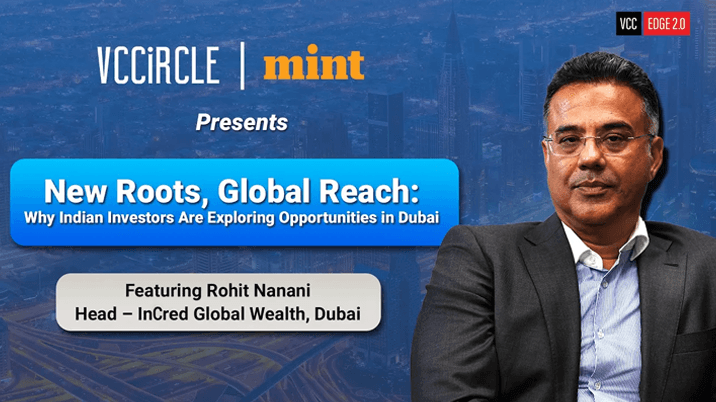
As Indian ultra-high-net-worth individuals (UHNWIs) consider how to structure their wealth across geographies, Dubai is increasingly being evaluated as part of that equation. For some, it has become more than a financial jurisdiction, serving broader lifestyle, operational, and succession-related needs. This transition, while gradual, has been shaped by evolving preferences around residency, regulatory clarity, and proximity to global markets.
Mr. Rohit Nanani, who heads InCred Global Wealth’s Dubai business, reflects on how the city’s appeal began to shift during the pandemic. Families that relocated temporarily during COVID-19 found Dubai’s systems, infrastructure, and mobility to be conducive not just for a few months, but potentially for the longer term. “Through COVID, a lot of families moved, especially from Europe, the Far East, and also India, to explore Dubai as a destination,” he said. Some of these families have since chosen to deepen their presence.
Mr. Nanani points to factors such as streamlined residency options, access to services, and global flight connectivity as part of what draws Indian-origin families to the city. For those with operations spanning multiple continents, Dubai’s strategic location, situated between Europe and Asia, provides a significant advantage. According to him, jurisdictions such as the Dubai International Financial Centre (DIFC), one of several regulated free zones in the city, contribute to building client confidence, especially when paired with Dubai’s broader ease of doing business.
In addition to regulatory access and lifestyle benefits, Dubai’s openness to global talent has become another driver for families and businesses seeking to scale beyond national borders. Mr. Nanani noted that, unlike other countries where restrictions on importing talent pose significant barriers, Dubai offers a more flexible and welcoming approach. “If you have a vision to expand outside, Dubai could be the regional headquarters,” he said.
He added that many clients conduct thorough due diligence across jurisdictions, yet often find Dubai’s offering to be more cohesive and competitive. “The challenges for the rich are not choosing destinations, it's choosing the right destination.”
For InCred Global Wealth, which established its regulated presence in the DIFC in 2020, this shift has been reflected in the profile of clients it now serves. Mr. Nanani notes that the firm increasingly works with Indian families based across the UK, Africa, India, the Far East, and North America, each with their interpretation of what a “localized” investment strategy means. For some, familiarity lies in UK-based products; for others, it may involve UAE-listed assets or India-linked investments. “It’s very relevant when we talk about localization of products and services, especially in a multi-cultural city like Dubai,” he explained. The firm’s approach is to offer multi-jurisdictional access through an extended partner network, rather than trying to cover all markets internally.
This diversity in investor origin is accompanied by evolving expectations around family office structures. While some clients establish single-family offices with dedicated CIOs and internal teams, others prefer more modular support. Mr. Nanani explains that InCred’s role is often to complement in-house functions, whether by offering access to capital markets, legal and tax advisors, or global structuring tools. These services are selectively engaged depending on client needs and asset thresholds.
Within families themselves, generational differences are shaping investment direction. Mr. Nanani observes that while first-generation wealth creators may be inclined toward capital preservation and conservative strategies, younger members often express interest in startups, emerging technologies, and alternative assets. “As an asset manager, we need to be aware of who we are dealing with, what their aspirations are, and that’s where the customization comes in,” he said.
Real estate continues to remain a significant part of the asset mix for Indian families. Based on Mr. Nanani’s experience, it often accounts for a notable portion of their portfolios, whether in India, Dubai, or other regions. He notes that Dubai’s property market, particularly in the luxury segment, has seen high transaction volumes recently. “The Dubai real estate market is booming. They had the largest volume of transactions in 2024 in the history of Dubai,” he pointed out. The firm, while not directly brokering real estate, works closely with established developers and partners to facilitate access for clients looking at property as part of their overall allocation.
The conversation also extends to the startup ecosystem. While Dubai may not offer scale in terms of consumer base, Mr. Nanani suggests that its focus on high-value sectors, including fintech, hospitality, and digital infrastructure, is driving new business formation and attracting capital. He described Dubai as a market that is “high in value, low in volume,” where startups solving for segments like hospitality, tourism, and food and beverage are gaining strong traction. “We are very excited about what’s happening in Dubai on digital payments, on digital banks,” he shared, adding that the city has seen increased activity in blockchain and AI-enabled sectors, supported by frequent trade fairs and policy focus on emerging technology.
Still, navigating a new jurisdiction requires careful consideration. Mr. Nanani underlines the importance of working with regulated advisors and institutions, particularly when it comes to cross-border planning. Zones like DIFC, in his view, help ensure client protection and transparency, while enabling access to a range of global financial services, forming part of a broader ecosystem of free zones and regulated entities that support cross-border investors in Dubai.
Looking ahead, Mr. Nanani believes the India–Dubai wealth corridor is likely to deepen. He cites historical, cultural, and trade ties that already underpin this connection, as well as growing regulatory engagement between bodies like SEBI, RBI, and the DFSA. The presence of a large Indian diaspora in the UAE, coupled with ongoing government and institutional cooperation, adds further momentum to this shift.
As wealth becomes increasingly mobile and structurally complex, Dubai is finding a place in the consideration set for Indian families. Whether as a regional base, a diversification strategy, or a hub for intergenerational planning, it is a destination that many are choosing to explore, guided not just by opportunity but by compatibility with long-term goals.
The insights in this article were drawn from a recent video interview with Mr. Rohit Nanani, Head – InCred Global Wealth, Dubai, where he shared perspectives on the evolving India–Dubai wealth corridor. Watch the full discussion here : https://www.youtube.com/watch?v=fO0UvhSR9R8
No VCCircle journalist was involved in the creation/production of this content.