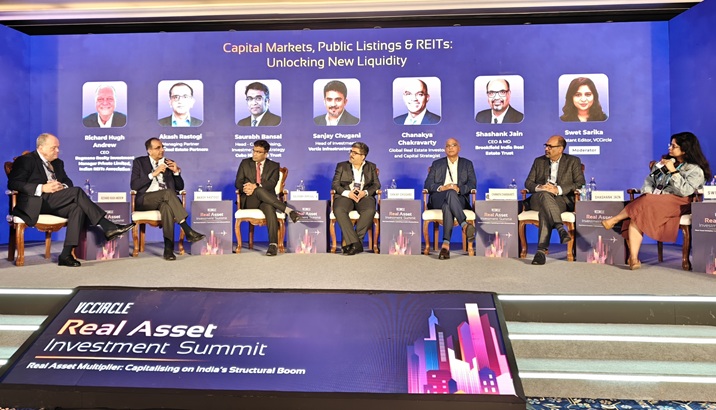
The market for listed real estate and infrastructure investment trusts in India is maturing beyond sponsor-led monetisation thanks to deeper domestic participation and broader asset classes like logistics, renewable energy, and transmission, amid stricter governance standards, industry executives said.
The executives, who were speaking at a panel discussion at the VCCircle Real Asset Investment Summit 2026 in Mumbai on Thursday, noted the factors behind the rise of real estate investment trusts (REITs) and infrastructure investment trusts (InvITs).
Richard Hugh Andrew, CEO, Bagmane Realty Investment Manager Pvt Ltd, spoke about India’s potential to run global capability centres (GCCs).
“This is a country that runs businesses globally. Only 35% of global GCCs have a footprint here. That category on its own shows you where the demand is. We see an enormous runway both for the international business community that wants to leverage that talent,” he said.
Akash Rastogi, Managing Partner at WSB Real Estate Partners, noted a marked rise in participation by domestic institutions, high-net-worth individuals, and family offices across operating assets and local market aggregation, even as foreign capital continues to play a vital role in riskier greenfield capex and large-ticket transactions.
“Domestic capital or fund managers are going to basically be able to aggregate those assets much faster because they’ll understand those markets far better than a foreign capital provider,” Rastogi said.
Rastogi said logistics will be the next asset class to join the REIT ecosystem as it has reached a significant scale.
Saurabh Bansal, head of capital raising, investments and strategy at Cube Highways Trust, said renewables and transmission were among the most scalable asset classes into the existing InvIT structure apart from roads. “That will be the source of growth, especially in the next two-three years.”
“Foreign pool clearly keeps on playing the part of risk capital, which means anything which is going towards capex building sectors which are still developing... and the domestic capital basically plays a part where the monetisation strategy... and the incremental investment in the low risk avenues such as roads, renewables and transmission, that's where domestic capital continues to be very strong,” he said.
Sanjay Chugani, head of investments at Vertis Infrastructure Trust, seemed to concur with these views as he saw roads being the primary driver of short-term InvITs.
“The next three years of demand will definitely come from roads… All the HAM (hybrid annuity model) assets which had been bid out in 2020-24 will also come back into the market. So, for the next two-three years, at least in terms of roads as a sector, we are sorted,” he said.
Cube Highways Trust and Vertis are highway-focused InvITs sponsored by private equity firms I Squared Capital and KKR, respectively.
Chanakya Chakravarty, a real estate investor and capital strategist, said listing REITs in the next couple of years was “not going to be as easy” as the interest rate and housing cycles were turning. For those who came to markets, valuations would be a “challenge”, he said.
“I’d stick my neck out and say because of what’s happening in the interest rate cycle, in the next 18 months, I would advise sponsors to keep dry powder because there’s going to be stress in this market, and there will be opportunities, quality opportunities at a potential discount to them,” he said.
As the ecosystem grows from its early sponsor-led phase, Shashank Jain, CEO and MD, Brookfield India Real Estate Trust, stressed that arm’s-length governance, manager discipline, and ongoing investor education will be decisive in building long-term confidence and expanding market depth.
“That governance lens, that discipline by the manager, has to be sacrosanct... We are talking about a billion square feet of Grade A market where REITs have just a 20% stake. Globally, 60% is held by REITs out of the total real estate stock.”