The Engine Room
AlphaVerse spent its first year building for institutions. Now it wants to take the same investment intelligence infrastructure to a much wider market.
There is a moment familiar to anyone who has ever taken investment advice. You read a recommendation. It sounds sensible. You trust the person who wrote it. And then you sit there, cursor hovering and think: yes, but is it right for me?
That hesitation points to a broader challenge in India's rapidly expanding retail investing ecosystem.
The country has built extraordinary access to its capital markets, helped by digital brokers, investment platforms and increasingly frictionless execution. But access to regulated, contextual and portfolio-specific investment intelligence has not developed at quite the same pace. Analysis often sits in one place while action happens somewhere else.
AlphaVerse is trying to close that gap by building a common technology and intelligence infrastructure spanning investment research, portfolio analytics and regulated advisory distribution.
One engine, four surfaces
Edhaz Markets Private Limited operates the AlphaVerse suite and its architecture explains much of its ambition.
At the base sits a single data foundation: 2.79 million price records across 3,359 securities, more than 14,000 mutual fund schemes and fundamentals covering 2,329 companies. Everything above draws from that one source.
AlphaMarket remains the advisory marketplace where SEBI-registered research analysts publish structured strategies that reach investors inside their own broker's terminal.
AlphaLab is the research workbench, offering geometric pattern recognition across fourteen families, discounted cash flow valuation, backtestable strategies and screening across 2,200 listed names.
AlphaLens focuses on portfolio intelligence, with a dedicated build for SEBI-regulated Alternative Investment Funds and another covering the mutual fund universe.
Each is a product in its own right. None of them is a separate company.

"Most platforms in this market are a feature that grew a business around it. A screener. A basket. A community. We went the other way." - Monjit Gogoi, Co-Founder & Chief Executive
"We built the engine first and exposed it four different ways," Gogoi continues. "The same calculation that tells a fund manager why he underperformed last quarter is what tells a retail investor whether an idea belongs in his portfolio. It is one piece of mathematics. It should not be four companies."
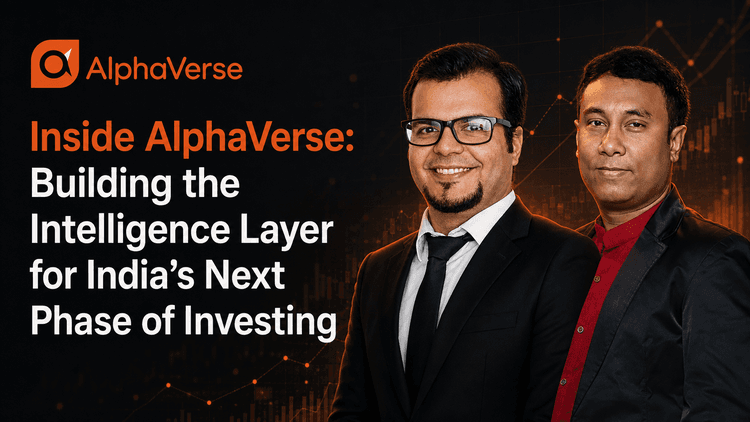
Gogoi and co-founder Amit Achhpal are not new to the problem. Gogoi built and scaled William O'Neil's India retail and AIF businesses. Achhpal spent his career architecting enterprise systems inside institutional finance. Between them they have watched analysis and action drift apart for two decades.

"We had both spent years on the other side of this," says Achhpal, co-founder and chief business officer. "You would build a beautiful piece of research and then watch it reach the investor as a forwarded message, stripped of its risk parameters and its time horizon. The intelligence survived the journey. The context did not. That is what we set out to fix. Not the research itself, but everything that happens to it afterwards."
What the engine actually does
The differentiation shows up in some of the less glamorous parts of the product.
The attribution engine implements Brinson-Fachler decomposition, the institutional standard for separating what a manager earned by choosing sectors from what he earned by choosing stocks. During evaluation with one of India's leading AIF and mutual fund houses, it was tested against the institution's own published fact sheets period by period. It matched.
The mutual fund product looks through to underlying holdings rather than stopping at net asset value. That allows it to answer a fairly simple but often overlooked question: you own six funds, but how many of the same eleven stocks do you actually own?
The research workbench detects chart patterns geometrically rather than probabilistically, making each identification reproducible rather than simply asserted. The advisory layer also carries SEBI restrictions inside the workflow itself. An analyst cannot publish a call on a security that his firm is restricted from covering because the system will not permit it.
For Achhpal, that restriction layer is the part he is proudest of and perhaps the part most users will never notice.
"Compliance is usually a document somebody signs after the fact. We made it a property of the system." - Amit Achhpal, Co-Founder & Chief Business Officer.
"An analyst does not have to remember what he is restricted from covering because the platform will not render the option," he says. "That is a harder thing to build than a dashboard and it is the reason an institution lets us sit inside their terminal."
It is this quality that has also become an unexpected commercial advantage. AI assistants and conversational interfaces are quickly becoming familiar features across India's financial services ecosystem. AlphaVerse is taking a different view of where the real defensibility lies.
"A chat interface over a language model is a feature, not a moat. Anyone with an API key ships one in a quarter. Ours computes rather than generates. Every number we put in front of an advisor traces back to the calculation that produced it," Gogoi says.
For regulated financial institutions, that distinction matters. As AI and automated intelligence tools find their way into financial services, institutions need to know where an output came from and how it was calculated. A number that can be traced back to its calculation is easier for an institution to validate than one generated without a clear audit trail.
The B2B year
AlphaVerse went to institutions first and did so deliberately.

The platform is now working with over half a dozen brokers and institutional clients, with integrations spanning brokers, asset managers and financial technology platforms. For AlphaVerse, this institutional-first approach has provided a way to test the underlying infrastructure before taking the brand and its technology to a wider group of individual investors. The company has raised no external capital and has never spent on customer acquisition. Its revenue has grown through the year almost entirely from within existing accounts, with partners adopting additional modules rather than growth depending solely on new clients. The company says no account has left.
"In regulated financial infrastructure, institutional validation is the moat. An asset manager will run three months of diligence on you before he signs anything. Once he has done that and gone live, he does not switch. We wanted institutions to stress-test the engine before we took it anywhere near a consumer." - Amit Achhpal
Earning the retail relationship
That test has largely been passed and the next chapter is the one the company has been building towards all along. Substantial retail trading turnover already flows through platforms powered by AlphaVerse. But today the relationship largely belongs to the broker and AlphaVerse remains invisible inside it.
The company wants to change that gradually rather than through a big consumer launch.
The first step is attribution. AlphaVerse-branded intelligence would begin appearing inside partner applications so an investor knows whose research or intelligence they are acting on. Over time, the company hopes this recognition can translate into a more direct relationship with investors.
Between the two sits India's last mile: close to 2.75 lakh registered mutual fund distributors, alongside a comparable population of authorised persons and sub-brokers who already have relationships with retail investors. For AlphaVerse, the opportunity is to equip these intermediaries rather than try to replace them. That could give the company a route to millions of investors without having to build a massive distribution organisation of its own.
"Groww won on mutual funds alone. Zerodha won on cheap execution alone. Breadth is what you offer a customer after you have earned him. It is never the reason he arrives." - Monjit Gogoi
From access to intelligence
The opportunity for AlphaVerse also sits within a larger change taking place across India's investment ecosystem.
The first phase of wealthtech was largely about access. It made investing easier, lowered transaction costs and brought financial products onto digital platforms. The next phase looks increasingly likely to be about intelligence.
Investors want to know what they actually own across different products. They want to understand whether several mutual funds are giving them genuine diversification or simply exposing them to many of the same stocks. Advisers need to understand whether a new idea fits into a client's existing portfolio. Institutions need to explain where performance came from and increasingly need to know how an automated or AI-assisted system arrived at an answer.
These are harder problems than putting a buy button on a screen. For AlphaVerse, its institutional deployments provide a testing ground for the underlying engine. Brokers, asset managers, distributors and other intermediaries can then provide the distribution needed to take that intelligence to a much larger retail market.
The challenge now is different from the one the company spent its first year solving. It is no longer simply about proving that the technology works inside an institution. The next test is whether institutional-grade investment intelligence can be made useful, understandable and trusted by an individual investor.
If AlphaVerse can make that transition while retaining the computational and compliance architecture it built for institutions, it may find itself occupying an interesting layer in India's wealthtech ecosystem: not simply another investment platform, but part of the intelligence infrastructure sitting underneath it.
NOTE: This article is a research piece written by VCCEdge Research Team
Insights Focus is a marketing initiative for sponsored posts. No VCCircle journalist was involved in the creation of this content.