Operating partners already know which companies hold years of real work records. The discipline is keeping the introduction out of the valuation case.
Board decks are full of operating history. Ten years of support tickets behind the NPS number. A CRM that has tracked every enterprise deal since the Series A. An engineering org whose issue tracker reads like a company autobiography. Investors usually see those systems as cost centers or diligence material. Increasingly they are something else as well: records of real work that AI developers want for training and evaluation and that some established companies now license.
That makes a portfolio company data referral a fair question for operating partners: would leadership at this company like to assess whether selected records could be licensed? Asked well, it's a useful, low-cost option for the company. Asked badly, it becomes an unapproved data sale dressed up as a value-creation lever.
THE SHORT VERSION
Portfolio companies with years of support, CRM or engineering history may be able to license selected records for AI training. A licensing option is not contracted revenue. Keep it out of the valuation case and management targets. Investors can introduce leadership and earn a capped referral reward, but only after clearing their own fund and fiduciary rules.
A licensing assessment is an option for the company to explore, not a number for the valuation case.
Which portfolio companies are worth a look?
The first screen is about the company, not the data, and you likely know the answers from ordinary oversight:
Full-time headcount at peak; the core fit is 50 or more, excluding contractors
Several years of operating history
Systems with connected histories of work, such as support, CRM, engineering and documents; qualifying companies list at least five
Geography and language: U.S. companies are prioritized and Canada and the EU qualify, while India, the UK, Singapore, the UAE and other listed markets qualify when at least 90% of the data is in English
Don't overlook the tail of the portfolio. Companies that have been acquired or have wound down can also qualify, so the archive at a shuttered holding may deserve a conversation.
Knowing these facts through a board seat is not authority to license anything. Management appoints the people who assess rights, confidentiality and scope. Customer commitments and ownership structures can complicate a dataset even when the cap table is simple.
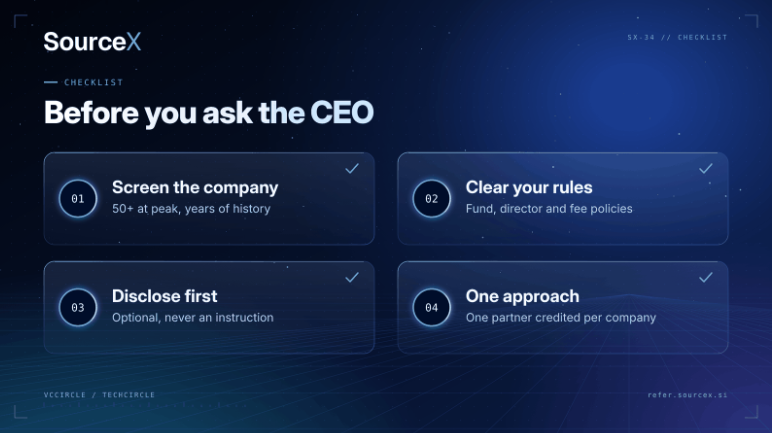
Four checks before an investor or operating partner raises a data licensing introduction.
Should a licensing opportunity go into the valuation case?
Keep a possible licensing payment separate from contracted income and recurring operating performance. A SourceX deal still has to clear qualification, dataset acceptance and Closing before an invoice, followed by payment on the agreed terms. Usually it is a one-time fee per dataset; some agreements specify recurring deliveries. Finance must assess accounting treatment separately from this cash timetable.
Treat any early estimate as an assessment input only. It shouldn't become a management target or evidence that every company in the portfolio holds the same asset. Leadership may reasonably decide that preparation effort, exclusivity or rights restrictions outweigh the money, and that's a legitimate outcome.
An option worth exploring is not an asset worth booking.
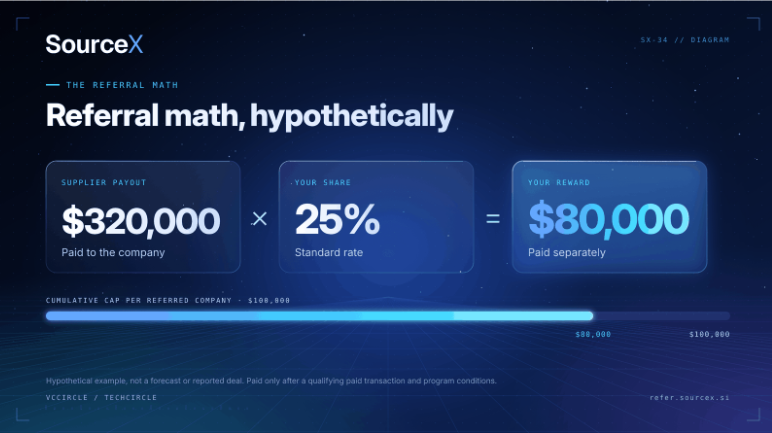
Hypothetical example of the standard formula: 25% of the actual supplier payout, capped at $100,000 per company. Not a forecast for any company or fund.
How do referral rewards work for investors?
The SourceX referral program names private equity and operating partners among potential referrers. Its standard reward is 25% of Actual Supplier Payout, with a $100,000 cumulative cap per referred company across installments, agreements, repeat licenses and renewals. The signed Channel Partner Agreement's Schedule A and any agreed addendum control the rate, base and cap.
Actual Supplier Payout means compensation actually paid for selected data that reaches Closing and the qualifying completed handoff. It excludes itemized taxes and expense reimbursements, the partner reward, SourceX's fees and the Acquisition Partner's full transaction price. Unpaid estimates do not count; installments accrue as paid. The $100,000 company cap does not reset.
Hypothetical: a qualifying deal that paid a portfolio company $320,000 would generate an $80,000 reward. That's arithmetic, not a forecast for any company or fund.
Rewards are paid separately and never deducted from the company's agreed compensation. They require a qualifying completed transaction and all payment conditions. An introduction, management meeting or signed agreement alone earns no payable reward.
The reward deadline is 60 calendar days after the later of the Acquisition Partner's final written, unconditional acceptance and completed handoff of the complete, validated and approved dataset. Payment also requires cleared buyer funds at SourceX, the supplier's payment, finance approval, your payment and tax details, and lawful payment. If a condition is outstanding at the deadline, payment follows promptly once it is met; no new 60-day period starts. This is separate from the supplier's invoice timetable.
How do you keep conflicts and authority clean?
Before making introductions, obtain an approved partner account and sign the SourceX Channel Partner Agreement. Check your own contractual or professional duties, disclose the incentive and get the company's permission. A referral never authorizes access to its records.
Before anything else, confirm whether you, your fund or your firm may receive this compensation at all under fund documents, allocation policy, director duties and any professional rules. The referral program can't answer those questions. Your own counsel and policies must. Then disclose the potential incentive to the company before you make the introduction, and make it clear the idea is optional. A suggestion from a shareholder can feel like an instruction. This one shouldn't.
How does attribution work across a portfolio?
Credit goes to the first valid introduction of a new company within the 90-day attribution window when it submits a verified application. SourceX checks dated written introductions, existing applications and prior relationships; an earlier click alone does not secure credit. Earlier leads, accounts or email correspondence can make a company a duplicate. Only one partner is credited per company. Coordinate internally so several people from one fund do not approach the same CEO.
What should an operating partner do next?
Pick one company with a plausible fit, clear your internal approvals and obtain partner approval and a signed Channel Partner Agreement. Then ask the authorized leader whether an introduction would be useful. The initial company fit check uses broad facts, with no record uploads or commitment.
Start with one real company decision, not a speculative sum of every record across the portfolio.
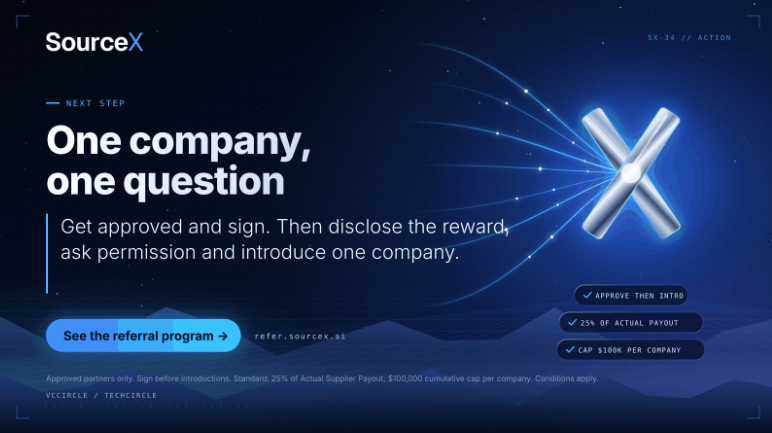
Leadership decides. The fit check involves a few questions and no uploads.
Review the SourceX referral program alongside your fund and conflict policies. If approved internally, obtain partner approval and sign the Channel Partner Agreement before introducing one company. A standard reward of 25% of Actual Supplier Payout, capped cumulatively at $100,000 per company, is conditional income rather than a portfolio valuation assumption.
About the founder
Noah Loul is a four-time founder and the founder and CEO of SourceX, which licenses business data directly from companies for AI training and evaluation. He previously founded B2B Rocket, acquired by Blackpearl Group. His work focuses on building permission-based data infrastructure for AI.
Insights Focus is a marketing initiative for sponsored posts. No VCCircle journalist was involved in the creation of this content.