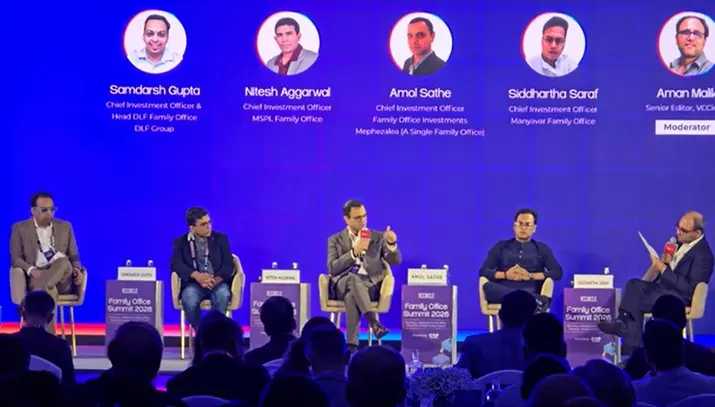
Indian family offices are increasing allocations to gold and building out multi-country investment structures as they navigate an increasingly unpredictable geopolitical backdrop, industry executives said at the VCCircle Family Office Summit 2026.
The executives, who were speaking during a panel discussion at the event in Mumbai on Friday, included Amol Sathe, CIO at Thermax promoters’ family office Mephezalea; Siddharth Saraf, CIO at the Manyavar (Vedant Fashions) family office; Nitesh Aggarwal of the Baldota family office, and Sandarsh Gupta of the DLF family office. These executives oversee family office capital with exposure spanning Indian equities, unlisted and venture investments, and international allocations across the US, Europe, Southeast Asia and the Middle East.
Sathe said geopolitical risk is the biggest macro risk family offices face today — but also the easiest to manage, precisely because its only certain feature is uncertainty. “No one knows how geopolitics will turn out. It is in the hands of a few powerful people, and no one in the world knows what they are going to think tomorrow,” he said.
That unpredictability is what has pushed his office toward gold, he said. “Gold loves any kind of uncertainty in the world — geopolitical, financial, whatever.”
He compared the allocation to term insurance. “The opportunity cost is 100% if nothing goes wrong, but we do it because it’s insurance.” He added that gold has delivered strong returns recently, “but that was not the intention when we did this”.
Sathe said the office has recently begun accumulating physical bullion held in Zurich, in addition to existing financial gold exposure, citing tail risks such as a major cyberattack on digital financial infrastructure. “What happens? You are completely out, you have lost everything. Only one thing will save us from that, and that is bullion.”
Saraf said his family office does not currently hold gold, noting the asset class has produced highly varied returns across different market cycles. “From 2011 to 2019, gold has given zero return,” he said, though he added that “whether we should have an allocation because of this uncertainty in the market — I think one should have some allocation for sure.” Saraf’s family office remains close to 80% weighted toward Indian listed markets, he said.
Aggarwal named artificial intelligence, rather than geopolitics, as the macro shift that has most affected his family office’s thinking. “A once-in-a-decade event has started happening once a week,” he said, pointing to Adobe as an example of a company whose stock has come under pressure amid investor questions about whether AI threatens its business model. He said the office’s central filter now is “whether the company will exist or not going forward” given the pace of AI-driven disruption.
Global allocation
Gupta, whose family office invests both in India and internationally, said the two portfolios are managed in tandem. “India and international investments go hand in hand for us,” he said, adding that large-cap Indian equities have been a “no-go space” for the office over the past year amid sustained foreign fund outflows from such stocks.
Internationally, he said the office tracks both earnings growth — citing South Korea, Taiwan and the US — and capital-flow direction, noting capital has recently rotated out of Korea and into China even as Korean earnings growth continues.
He said the office currently favours US industrials exposure outside the seven or eight mega-cap technology names driving the S&P 500’s AI-linked gains, on the view that “that development phase has, to a certain extent, played out” and that adoption among the index’s remaining roughly 493 constituents represents the next opportunity.
Sathe’s family office runs its non-India investments — more than a third of total family wealth — out of a Singapore entity, a structure built over roughly 15 years “because of the geographical diversification requirement”. He said the office has been “moving away from the US” over the past two years on valuation concerns, while increasing exposure to Germany, Switzerland and Southeast Asia through customised structured notes, which he said have delivered coupons of roughly 12-14% in US dollar terms, net of costs.
Aggarwal’s family office runs roughly two-thirds of its book in India and one-third outside — a split he said was a deliberate diversification decision rather than a recent shift. The office invests across most major regions but has avoided Latin America and Africa. On Africa, he said: “It's very attractive, but the government risks... you need someone on the ground to invest,” comparing its current stage to China roughly a decade ago.
Private markets and real estate
Aggarwal, whose family office runs an unlisted-focused portfolio, said deployment pace has increased every year for several years running and is set to rise again this year, a trend he attributed to internal allocation strategy “and that’s actually got nothing to do with the geopolitical... macro environment”.
He said falling valuations and a shift among founders toward profitability — rather than growth at all costs — have made it easier to deploy capital, even as portfolio-level growth has moderated to an estimated 20–30% over the past year, from 60–70%-plus previously. “Profitability has gone up a lot more... that demand is a healthy sign and makes it easier for us to invest.”
Asked about diversifying away from the family’s core commodity- and policy-linked businesses, he said the family office capital is “non-strategic pool capital”, which the office is trying to diversify independent of the family’s operating business.
Saraf, whose family office runs roughly a fifth of its portfolio in private equity and venture capital, said listed markets currently offer better relative value than private markets after a roughly two-year period of consolidation. “I believe we are getting better value in the [listed] space now... and having liquidity there makes more sense, too.”
Within listed markets, he said large-caps look more fairly valued than mid- and small-caps, which he said have “become rather more expensive” following the sell-off earlier this year, though he continues to find pockets of value on a “bottom-up stock approach” across market caps. He said his office does not run index-based mandates but is open to the approach, and is also weighing an entry into real estate.
Gupta said Dubai stands out among international real estate markets for family office capital. “Real estate there is not real estate as such — it’s a financial product,” he said, citing rental yields of around 10-11% against roughly 7-8% for comparable Indian commercial assets, translating into cap rates in the low-to-mid teens.
He said Dubai residential prices have corrected by roughly 15-20% recently even as buyer demand for those assets has picked up, while commercial real estate supply remains constrained, with the next major commercial project not expected to open until 2027.