Seventeen years ago, when Steadview first began investing in India, the private ecosystem barely existed. In 2025 alone, private equity and venture capital investors have deployed $30B+ across 1,000+ transactions. I have had the privilege of watching the ecosystem mature from close quarters at Steadview. We began as a public-markets investor and, over time, started investing in private markets and became a partner to founders across India and the US. Steadview has deployed over $1.5 billion at cost in private equity across 50+ companies globally, with around 20 exits, mostly IPOs. We have partnered with some of the most iconic companies in India including Lenskart, Eternal, Urban Company, PolicyBazaar, Nykaa, Flipkart and Aequs to name a few. We remain excited about the decade ahead, which we believe will be even more consequential given some of the interesting shifts already underway in the ecosystem, several of which I'll unpack below
Accelerated Shift in Ambition and Speed
A decade ago, India had majority of start-ups adapting western models to local conditions. One major shift seen today, is founders building category-defining companies with no external reference point, tackling more complex problems across evolving domains such as precision manufacturing, space-tech and defence. This ambition is no longer confined to domestic markets - several companies now start with a global mindset from day one. Equally important is the growing cohort of second-time founders who have already lived through a company's full arc and bring that hard-won experience to their next venture
The early signs of this are visible within the Steadview portfolio itself. Lenskart and PolicyBazaar are scaling internationally. Ultrahuman has built a globally competitive hardware business out of India. Deepinder Goyal, having built Eternal into India's most valuable tech company, is now in his second innings with Temple, where Steadview had the privilege of partnering early. These are only select examples of the wider ecosystem's growth in ambition.
Building Right, Not Just Building Fast
The second shift is subtler: growing discipline in how companies are built, not just how fast they grow. Founders today speak fluently, even early on, about unit economics and capital efficiency. Nykaa, when we invested privately in 2019, was a rare example of capital-efficient scaling. We now see that discipline across sectors and stages. For instance, INDmoney, in our portfolio, continues to grow over 100% year-on-year, while sharply increasing profitability.
Having had experience of investing in public companies, I regard this as a genuine unlock, both of mindset and of capital access. This impact has been visible in late-stage companies, with new-age technology companies listings rising from five in 2023 to eighteen in 2025, and this cohort has, on aggregate, performed well in the public markets. This combination of growth with bottom-line discipline represents a considerably healthier foundation for the ecosystem.
Where We See the Opportunity Set Moving
From our vantage, a few structural shifts stand out as the most investable themes for the coming decade. Enterprises are moving from AI experimentation to real operational change, and AI-native services companies are turning project-based work into scalable, recurring-revenue. Consumer brands also breaking out at scale, using improving payments rails and quick-commerce distribution to build genuinely omnichannel businesses with healthier unit economics. App-first lending built on alternative data continues to compound well in financial services, alongside continued strong tailwinds in wealth-tech space. Manufacturing is being reshaped by China+1 diversification and PLI support, turning India into a credible precision-engineering and deep-tech base. Taken together, these shifts point to ecosystem maturing beyond consumer internet cycles into deeper, more durable categories of value creation.
Our Thesis on What It Takes to Succeed
Our conviction in India has evolved consistently. We arrived as public market investors, reading the country through its listed companies. As the private ecosystem matured, we moved from being observers to active investors and over the past decade have made investments across sectors. There are a few learnings for us as we look at the next decade of investing in India
The first is breadth. A single thematic fund works well until that sector's moment passes. We have chosen to stay multi-sectoral, because the category leaders that emerge from India are unlikely to come from only one part of the map. In late 2022 and 2023, as tech funding slowed, we shifted focus towards precision manufacturing, where we backed Aequs, which has since gone public and continues to execute exceptionally well.
The second is the ability to add value to your portfolio. Founders care whether their investors help them think more ambitiously, expand into new markets, and access the next pool of capital. Our capacity to stay engaged from an early private round through listing and beyond, with real presence in Silicon Valley and Mumbai, extends value well beyond the size of a cheque. In the last twelve months, we have shared portfolio insights, helped founders map new markets, and supported several companies through their IPO journeys.
The third, closest to Steadview's own background, is a public-market lens applied early. Public markets are unforgiving about two things: whether a company's unit economics actually work, and whether it has a genuine, defensible edge rather than a narrative borrowed from a category leader. Applying that scrutiny early shapes better decisions long before a listing is ever contemplated.
The next decade will test many of today's assumptions, including our own. Steadview's approach has been to stay close to the ecosystem, back conviction with capital, and remain willing to change our mind as the market evolves. That discipline has defined our first seventeen years in India, and it will define the next.
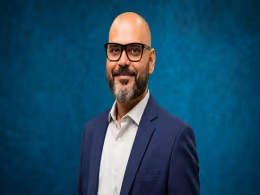
NOTE: This Thought Leadership article is authored by Joy Bhakat, Co-Founder & Head Of Investments, Steadview Capital
Insights Focus is a marketing initiative for sponsored posts. No VCCircle journalist was involved in the creation of this content.